Manipulation is where open robot data is richest, and where the licence terms vary most. The ordering below is by usability rather than by size, because the biggest single-platform dataset here is one many teams cannot touch.
DROID: the most usable large dataset
DROID is in-the-wild single-arm manipulation on a standardised rig, and it is the one to start with for commercial work because its licence is clean: CC BY 4.0, stated in the paper.
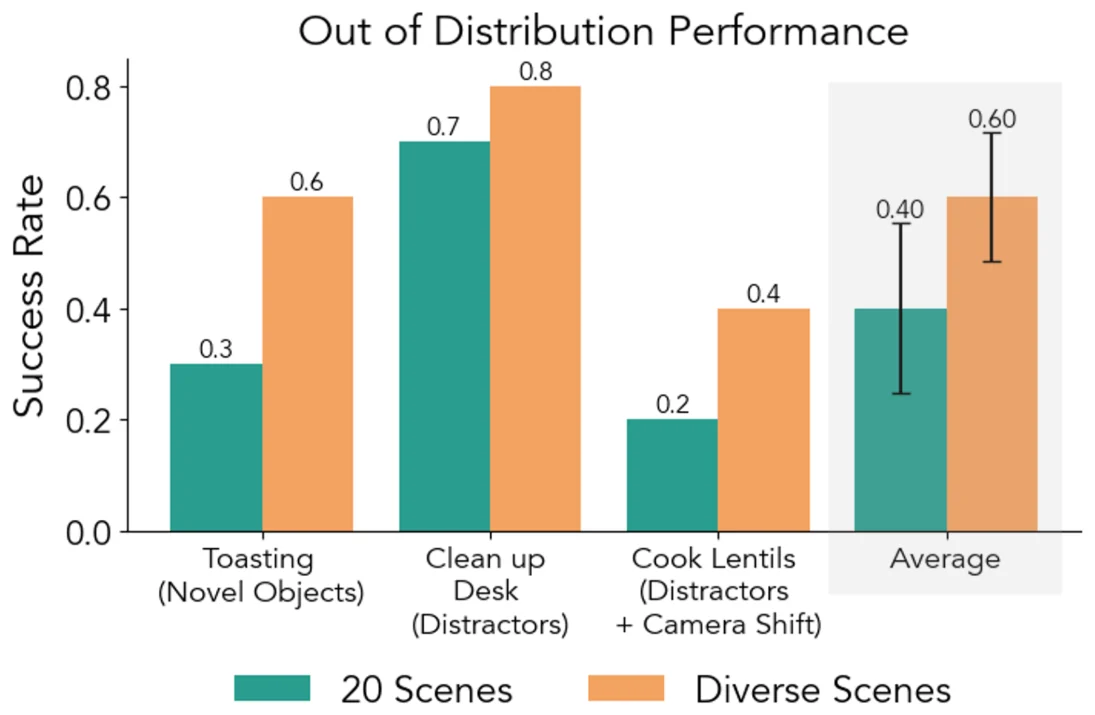
Scale, as published: “76k demonstration trajectories or 350 hours of interaction data” across 564 scenes and 86 tasks, collected by 50 data collectors over 12 months across 52 buildings.
The hardware is specified precisely, which matters for transfer: a Franka Emika Panda 7-DoF arm with a Robotiq 2F-85 gripper, three ZED stereo cameras (two adjustable exterior plus a wrist-mounted ZED Mini), teleoperated through a Meta Quest 2.
One inconsistency to be aware of if you cite it: the paper's introduction says 18 research labs while its methods section says 18 robots and 50 collectors across 13 institutions.
AgiBot World: the largest single-platform set, and non-commercial
AgiBot World Colosseo is the largest single-platform open manipulation corpus: “1,001,552 trajectories” totalling “2976.4 hours”, from “more than 100 homogeneous robots”, covering 217 tasks, 87 skills and 106 scenes across five domains — domestic, retail, industrial, restaurant and office.
The hardware is a dual-arm humanoid: two 7-DoF arms, mobile chassis, adjustable waist, interchangeable grippers or 6-DoF dexterous hands, tactile sensing on some tasks, eight cameras, recorded at 30 Hz. Collection happened in a purpose-built facility of over 4,000 square metres, using both VR headset control and whole-body motion capture, with human verification. A nice detail: failure-recovery episodes make up about 1% of the dataset, which is deliberate and useful.
And the licence is CC BY-NC-SA 4.0 — non-commercial and share-alike. This is the single most consequential licence fact in open robotics: the biggest single-platform and arguably best-organised manipulation corpus is unavailable for commercial training.
It trains GO-1, a hierarchical vision-language-latent-action model, and is the sole training corpus for the Genie Envisioner world model.
The rest, with what they are for
Beyond those two, the landscape sorts by hardware cost and by whether the data is pooled. The table repeats DROID and AgiBot World for comparison.
| Dataset | Scale | Platform / note | Licence |
|---|---|---|---|
| DROID | 76k trajectories, 350 h, 564 scenes | Franka Panda, in the wild | CC BY 4.0 |
| AgiBot World | 1,001,552 trajectories, 2,976 h | dual-arm humanoid, facility-collected | CC BY-NC-SA |
| BridgeData V2 | 60,096 trajectories, 24 environments | WidowX 250, rig costs ~$4,000 | CC BY 4.0 (project page) |
| Open X-Embodiment | 1M+ trajectories, 22 embodiments | pooled from 60 datasets | aggregate CC-BY; per-dataset not stated |
| AgiBot-Alpha | 140,000 trajectories, 1,979.4 h | appears in GR00T N1's mix (N1.5 used AgiBot-Beta) | see AgiBot terms |
What a per-task collection actually costs
The published per-task numbers are the most practically useful figures in this area, because they tell you what a collection campaign involves.
ALOHA: “we record 50 demonstrations for each task, except for Thread Velcro which has 100”, with each episode taking “8-14 seconds for the human operator to perform”. The whole bimanual rig cost under $20,000. Success rates with that data vary sharply by task difficulty: 96% on Slot Battery, 88% Slide Ziploc, 84% Open Cup, 64% Prep Tape, and 20% on Thread Velcro even with double the demonstrations.
Mobile ALOHA: “only 50 human demonstrations per task” (two tasks used 20), on a $32,000 system, co-trained with a static ALOHA dataset of 825 episodes. The co-training gains are large and uneven — Rinse Pan went from 0% to 80%, Call Elevator 0% to 95%, Wipe Wine 50% to 95%, while two tasks did not move at all.
So the unit of work is roughly 50 demonstrations per task at around ten seconds each — minutes of robot time, but a rig, an operator and a setup per task.
How much to collect, and of what
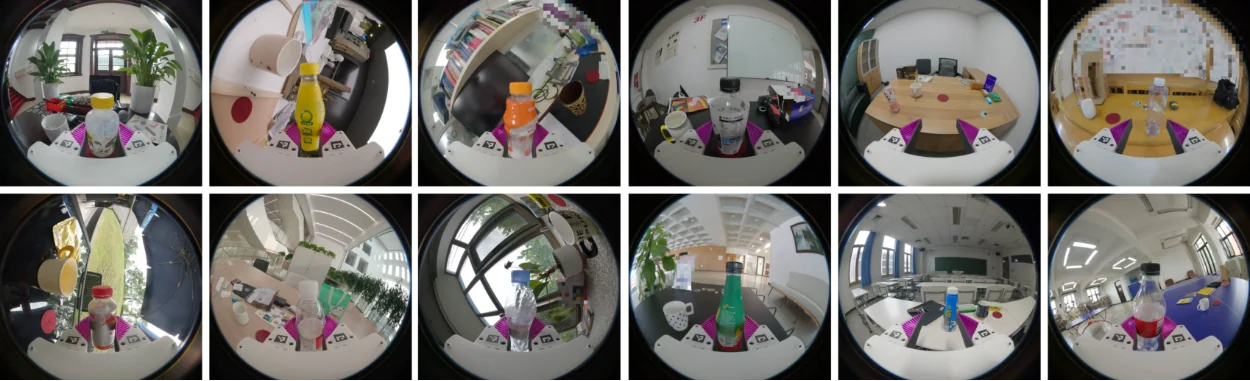
Data Scaling Laws in Imitation Learning gives the only solid published answer, and it is counter-intuitive: diversity beats count.
Generalisation “scales approximately as a power law with the number of training objects, training environments, or training environment-object pairs”, and “the diversity of environments and objects is far more important than the absolute number of demonstrations.” With the setting fixed there is no clear power-law relationship with demonstration count — performance simply plateaus, at 400, 800 and 1,600 demonstrations for 8, 16 and 32 environment-object pairs.
The recommendation: collect in as many diverse environments as possible with one unique object per environment, 50 demonstrations per environment-object pair, and 32 pairs is generally sufficient — about 1,600 demonstrations, reportedly reaching roughly 90% success on novel environments with unseen objects. The study itself collected over 40,000 demonstrations and ran more than 15,000 real-world rollouts to establish this.
If you are planning a budget, this is the number to plan against: 1,600 well-spread demonstrations, not 10,000 in one room.
Questions people ask
Which dataset should I actually pretrain on?
For commercial work, DROID plus a licence-audited selection from Open X-Embodiment. Better still, start from a released checkpoint already pretrained on such a mix — OpenVLA's run cost 21,500 A100-hours, which is rarely worth repeating.
Can I use AgiBot World for research and then switch for production?
Research use is within the licence. A model pretrained on NC data and then deployed commercially is the unsettled question, since whether weights are a derivative work is not clearly resolved. Teams that need certainty generally keep NC data out of any pipeline that leads to a product.
Is bimanual data worth it if my robot has one arm?
Partly. Cross-embodiment transfer does work, and OXE's shared 7-D action format exists for exactly this. But bimanual coordination is the thing a dual-arm dataset uniquely teaches, and that portion does not transfer to a single arm. Weight your mix toward embodiments resembling yours.
How many cameras do I need?
Depends on what you train on. OpenVLA filtered its pretraining mix to datasets with at least one third-person camera, so a wrist camera alone may exclude you from some pretrained policies' assumptions. A third-person view plus a wrist view is the common configuration and matches both DROID and much of the pooled data.