Code is the modality where training data licensing is most explicit, because source files carry their own licences and those licences have conditions.
The training data on this list comes in two kinds. Raw source corpora, for pretraining or continued pretraining on a language or ecosystem. And instruction data pairing a request with working code, for teaching a model to write to a specification. Execution-based benchmarks, where correctness is determined by running tests rather than by comparing text, are a third kind and are not covered here; they are what makes this the category where verifiable-reward training works best.
The licence issue is structural rather than incidental. A corpus scraped from public repositories contains files under many different licences, some of them copyleft with conditions on derivative works. The better datasets filter by licence and say which they kept; the weaker ones report a dataset-level licence that cannot actually describe the contents. If you intend to ship a code model, that filtering is the property to look for.

| Dataset | Modality | Size | Licence | Best for |
|---|---|---|---|---|
| StackLite - Stack Overflow Question Dataset (2016) | Text | 12M questions | CC BY-SA | Analysing how questions evolve by tag |
| SOAR ARC Train 5M | Text | 5M examples | MIT | Self-improving program synthesis models |
| StackSample | Text | 1,264,216 questions | CC BY-SA 3.0 | Automatic tag generation or recommendation |
| OpenCodeReasoning | Text | 735,255 examples | CC BY 4.0 | Reasoning models for code generation |
| OpenCoder SFT Stage 2 | Text | 436,000 examples | MIT | Generate accurate functional Python code |
| Magicoder OSS Instruct 75K | Text | 75,000 instructions | MIT | Respond to technical or programming requests |
| React Code Instructions | Text | 74,428 entries | MIT | Generative models for React front-end code |
| Rust: Java Test - Code comparison dataset | Text | 68,167 lines | MIT | Rust–Java code translation or generation |
| Titanium 2.1 - DevOps Dataset and LLM Model Architecture | Text | 31,700 prompts | Apache 2.0 | LLM performance on concrete DevOps tasks |
| Tachibana 2 - Code Reasoning with DeepSeek R1 | Text | 27,261 pairs | Apache 2.0 | Reasoning about programming logic |
| GitHub Code Snippets | Text | 97M snippets | Unclear — see below | LLMs for code generation or completion |
| GitHub AI Project Docs | Text | 3,296 documents | Research only | LLM handling of technical documents |
StackLite - Stack Overflow Question Dataset (2016)
- Size
- Over 12 million CSV/SQLite questions, with associated metadata
- Licence
- Creative Commons Attribution-ShareAlike (CC BY-SA)
Metadata for over 12 million Stack Overflow questions up to October 2016 in CSV and SQLite, including identifiers, dates, scores, tags and answer counts. Metadata only, with no question or answer bodies.
Analysing how questions evolve by tag over time, studying correlations between tags and scores, and exploring publishing trends by day of week.
Source: innovatiana.com
SOAR ARC Train 5M
- Size
- Around 5 million examples, solutions in Python code, JSON format or similar
- Licence
- MIT
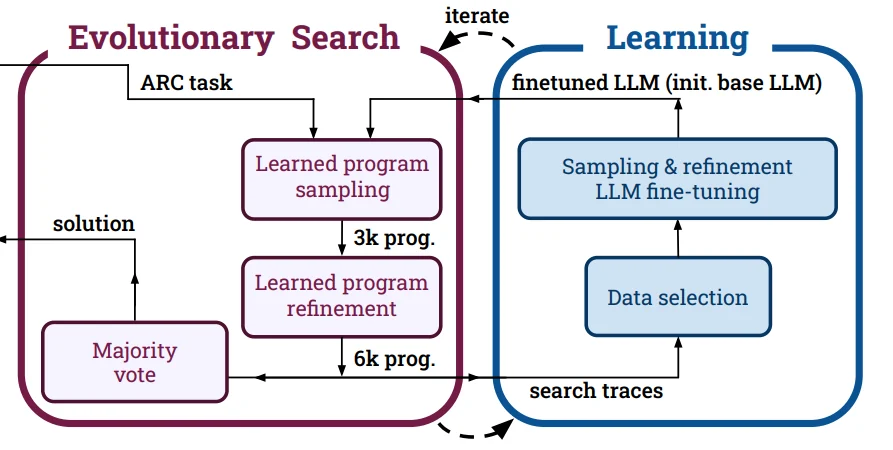
Around five million Python programs addressing the ARC benchmark, in JSON or similar, where failed solution attempts are relabelled against the outputs they do produce and recycled as training data. A self-improvement corpus.
Training self-improving program synthesis models, testing evolutionary learning on complex reasoning, and fine-tuning on algorithmic problem solving in Python.
Source: innovatiana.com
StackSample
- Size
- 1,264,216 questions, 2,014,516 answers and 3,750,994 tag rows in three CSV tables
- Licence
- CC-BY-SA 3.0
A 10 percent sample of Stack Overflow in three CSV tables: 1,264,216 questions, 2,014,516 answers and 3,750,994 tag rows. The relational structure supports tag prediction and question-quality modelling.
Training automatic tag generation or recommendation, predicting question success from text, and analysing technology trends through Stack Overflow.
Source: innovatiana.com
OpenCodeReasoning
- Size
- 735,255 examples in JSON structured text, Python source code, questions and solutions
- Licence
- Creative Commons Attribution 4.0 International (CC BY 4.0)
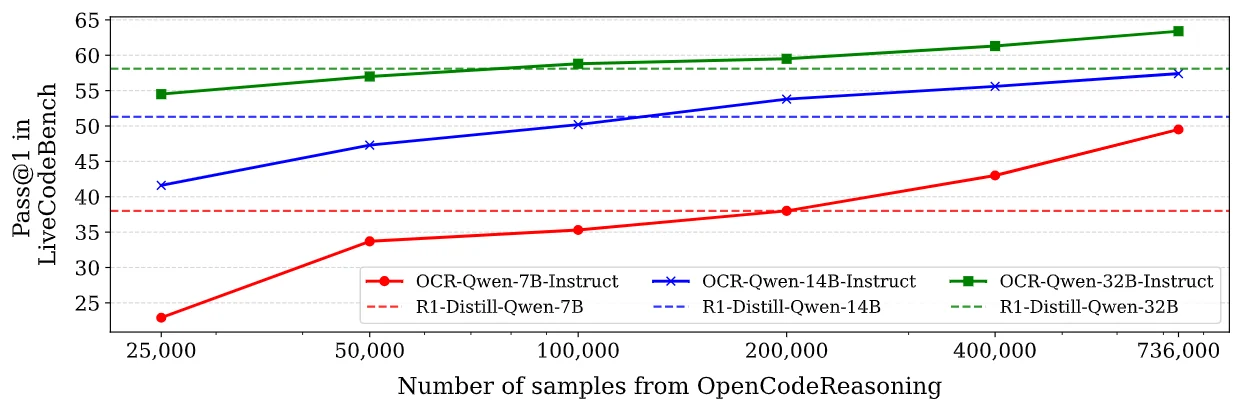
735,255 JSON examples built from roughly 28,000 competitive programming questions, each with the question, a generated solution and metadata. NVIDIA-published and large enough for serious code-reasoning fine-tuning.
Training and evaluating reasoning models for code generation, improving LLM performance on complex programming problems, and supporting supervised fine-tuning.
Source: innovatiana.com
OpenCoder SFT Stage 2
- Size
- About 436,000 examples in four JSON subsets (instruction, code, test case)
- Licence
- MIT
About 436,000 JSON examples across four subsets (the two largest alone hold about 289,000) holding instruction, code and sometimes test cases, drawn from educational data, Python documentation and validated synthetic instructions. The second-stage SFT mix for OpenCoder.
Training models to generate accurate functional Python code, evaluating algorithmic understanding on technical prompts, and improving SFT for development agents.
Source: innovatiana.com
Magicoder OSS Instruct 75K
- Size
- 75,000 instructions, JSON format
- Licence
- MIT
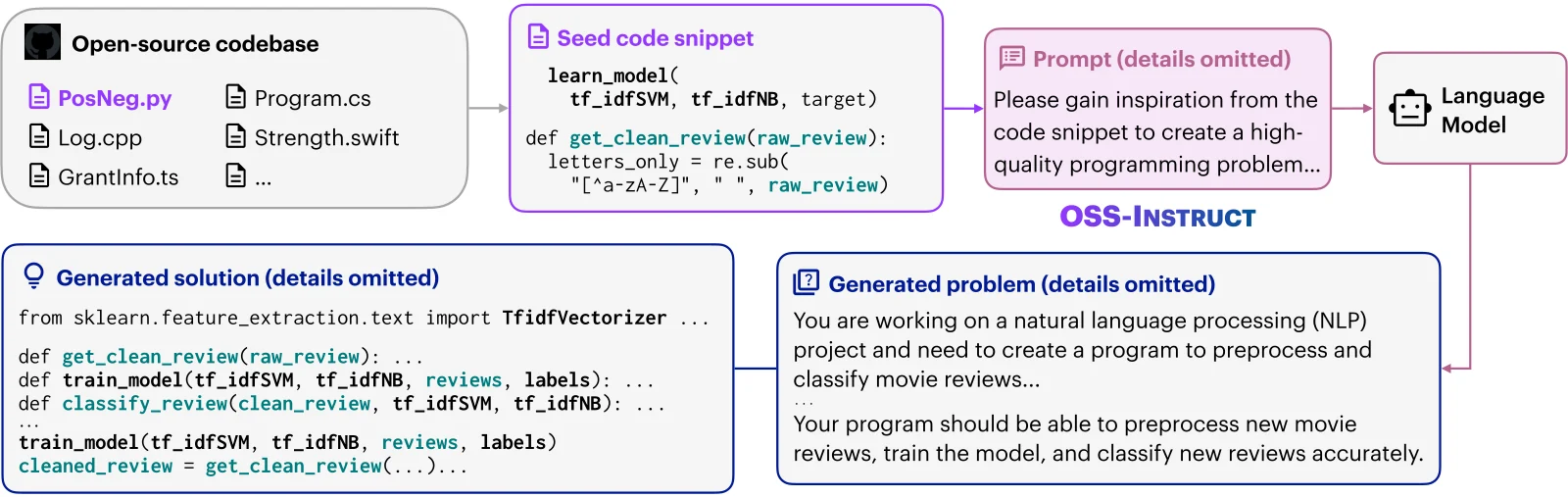
75,000 instruction-response pairs in JSON, generated with GPT-3.5 from real open-source project code rather than synthetic templates. Built to train software development assistance models on authentic codebase patterns.
Training models to respond to technical or programming requests, building assistants specialised in open-source projects, and instruction tuning on real code.
Source: innovatiana.com
React Code Instructions
- Size
- 74,428 entries, text formats + Parquet (219 MB)
- Licence
- MIT
74,428 LLM-generated pairs of instruction and React code in text and Parquet formats, 219 MB, covering component and application construction. Narrowly front-end focused, which is unusual among code instruction sets.
Fine-tuning generative models for React front-end code, creating assistants that generate web interfaces, and rapid interface prototyping from natural instructions.
Source: innovatiana.com
Rust: Java Test - Code comparison dataset
- Size
- 68,167 lines (181 MB), text or parquet format
- Licence
- MIT
68,167 lines across 181 MB in text or Parquet, pairing Rust and Java tests, snippets and code for comparison work. Aimed at cross-language translation and comparative compilation study rather than single-language generation.
Training Rust–Java code translation or generation, evaluating compilation, security or readability across two languages, and testing programming automation.
Source: innovatiana.com
Titanium 2.1 - DevOps Dataset and LLM Model Architecture
- Size
- 31,700 prompt/response pairs, in JSON format
- Licence
- Apache 2.0
31,700 synthetic JSON prompt-and-response pairs on software architecture, DevOps and cloud scenarios, with answers generated by DeepSeek R1. One of very few open datasets targeting infrastructure reasoning specifically.
Evaluating LLM performance on concrete DevOps tasks, training models for cloud infrastructure and automation, and testing software architecture reasoning.
Source: innovatiana.com
Tachibana 2 - Code Reasoning with DeepSeek R1
- Size
- 27,261 quick-response pairs, 203 MB (Parquet), structured text
- Licence
- Apache 2.0
27,261 synthetically generated prompt-and-response pairs in structured text, 203 MB of Parquet, with answers produced by DeepSeek R1 and focused on programming reasoning rather than code completion alone.
Evaluating an LLM's ability to reason about programming logic, testing errors generated by very large models, and refining coding-assistant models.
Source: innovatiana.com
GitHub Code Snippets
- Size
- 97 million snippets, text formats (JSON or plain), multi-languages (Python, JS, etc.)
- Licence
- Labelled CC BY 4.0 by the uploader; the snippets come from GitHub repositories under their own licences
Over 97 million open-source code snippets in JSON or plain text, drawn from GitHub repositories with more than 10,000 stars, spanning Python, JavaScript, Java, C++, Go and Rust. The star threshold filters for quality, not for licence: the CC BY 4.0 tag is the uploader's, and each snippet stays under its repository's own licence.
Training LLMs for code generation or completion, creating Copilot-style development assistants, and analysing common code styles and syntactic structures.
Source: innovatiana.com
GitHub AI Project Docs
- Size
- 3,296 documents, 18M characters, .md and .rst formats
- Licence
- Apache 2.0 (source repositories); the card provides the data solely for research and evaluation purposes
3,296 documents totalling 18 million characters in Markdown and reStructuredText, collecting README files, configuration guides and other technical documentation from popular open-source AI projects on GitHub. The card provides it solely for research and evaluation and tells users to check each repository's licence.
Testing LLM handling of technical documents in real contexts, training on structured Markdown content, and creating agents that summarise or restructure READMEs.
Source: innovatiana.com
How this list was put together
Drawn from the datasets in Dataset Finder filed under this topic, then checked by hand against what this page covers. A tag is a filing decision, not a description, so records that carried the tag without being about the topic were removed, and relevant records filed elsewhere were added. The order puts the closest fit first.
Sizes and licences come from each dataset's own documentation, vague wording included. Where we found a re-upload or catalogue card stating a licence that the original release contradicts — a CC0 tag on Flickr photographs, MIT on data whose terms require a signed agreement — the entry gives the original terms and says so. The comparison table abbreviates licences; hover a cell for the full wording.