A labelling quote is a time per label, multiplied by a loaded hourly rate, by the number of people who label each item and by the review and rework on top. The pricing model only decides who absorbs the error when those estimates are wrong. Few vendors publish rates, so the most reliable check is to time a pilot batch yourself and rebuild the number.
Four pricing models, and who carries the risk
Every labelling price is one of four structures, or a blend of them. They differ less in the total than in who pays when the task turns out harder than the estimate: denser images, more ambiguous classes, a guideline that changes in week three.
Per-label pricing looks safest, and for a stable, well-specified task it is. Its weakness is the definition of a unit. A vendor quoting per box on images that average three objects will reprice when yours average fifteen, and a per-image price hides the same problem the other way round. Hourly pricing moves the productivity risk to you but makes guideline changes cheap: nobody renegotiates a unit price because a class was split.
A common blend is a short pilot billed by the hour, followed by a per-label quote once both sides know the real time per item. That is a sensible order of events, and a vendor that will quote a firm per-label price without seeing your data is pricing in a margin for the unknown.
| Model | You pay for | Risk sits with | Watch for |
|---|---|---|---|
| Per object or label | each accepted box, mask, tag or transcript | the vendor, on speed | who defines ‘accepted’ |
| Per hour | annotator and reviewer time | you, on productivity | hours you cannot audit |
| Per task (crowd) | a reward per task, plus a platform fee | you, on quality | invalid work, and the redundancy to fix it |
| Platform seat | software per user or per month | you, for everything but the tool | QA features kept for higher tiers |
What vendors publish
Most managed labelling companies publish no prices; our guide to labelling companies marks which ones are sales-led. The figures in the table were read on each provider’s own page on 31 October 2026. They are list prices for different things, so they cannot be compared line by line.
One change matters if you last priced this a year ago. Amazon Mechanical Turk closed permanently on 30 September 2026, and with it the Mechanical Turk workforce inside SageMaker Ground Truth; AWS’s Ground Truth documentation now points users to private or vendor workforces. Google Cloud’s Vertex AI pricing page lists no human labelling service either. Toloka suggests a price per project rather than listing rates, and most managed vendors quote on request.
Platform seats and labour are separate bills. A $23 seat buys a tool for an annotator you still have to pay; an hourly labelling rate normally includes the tool. Keep the two apart when you compare a project you run yourself, in one of the open-source annotation tools, with one you hand over; whether to hand it over at all is the subject of our guide to in-house, managed or crowd labelling.
| Provider | Model | What the page says | Source |
|---|---|---|---|
| Labelbox | per hour (labelling services) | “$8 per hour” and “Starting at $10 per hour” on its self-serve tiers; Enterprise custom | labelbox.com/pricing |
| Prolific | per task, plus a fee | fee “usually 42.8%” for companies, 33.3% academic; minimum pay £6 / $8 an hour, £9 / $12 recommended | prolific.com/pricing |
| SageMaker Ground Truth | per object, plus workforce | charged per dataset object reviewed; vendor workforces set their own price per label | aws.amazon.com/sagemaker-ai/pricing |
| Label Studio Starter Cloud | platform seat | $99 a month for up to 12 users, $49 a month per extra user | humansignal.com/pricing |
| CVAT Online | platform seat | Solo, or Team per user: $23 a month billed yearly, $33 billed monthly | cvat.ai/pricing |
A cost model you can rebuild
Strip away the packaging and every quote reduces to the five lines of arithmetic at the end of this section. Write them down before you talk to anyone: they turn a negotiation about price into a conversation about assumptions, which is the one you can win with data.
The term that dominates is seconds per object, and it is the one buyers rarely measure. The timings in the table give a sense of scale. Each was measured on a particular interface, dataset and workforce, so treat them as bounds rather than as rates to plug in.
Relative prices follow the same shape. Zhang and colleagues requested quotes from ten annotation providers and, taking a trimmed mean, found that a polygon cost about 0.30 of a pixel-accurate mask, a bounding box about 0.085 and a single point about 0.056. A quote that prices polygons close to precise masks, or boxes close to polygons, deserves a question about what is actually being drawn.
Within one annotation type, four things move the time: how many objects each image holds, how complex the shapes are, how often the annotator must stop and decide (rare classes, occlusion, ambiguous boundaries) and whether the decision needs domain knowledge. The published timings were for clear everyday objects. A tumour contour or a cluttered warehouse shelf will be slower, and the only way to know by how much is to time fifty of your own items.
| Annotation | Measured time | Source |
|---|---|---|
| Bounding box, high quality | about 35 s per box (ILSVRC) | Papadopoulos et al. 2017 |
| Bounding box, extreme clicking | 7 s per box | Papadopoulos et al. 2017 |
| Instance polygon | over 22 worker-hours per 1,000, about 79 s each | Lin et al. 2014 (COCO) |
| Mask, model-assisted | 34 s falling to 14 s per mask | Kirillov et al. 2023 (SAM) |
| Fine pixel labels, street scene | over 1.5 h per image; coarse under 7 min | Cordts et al. 2016 (Cityscapes) |
| Video mask | 37.8 s per frame with SAM on each frame, 4.5 s with SAM 2 | Ravi et al. 2024 (SAM 2) |
hours = items * (objects_per_item * sec_per_object + sec_per_item) / 3600
hours = hours * redundancy               # people who label each item
hours = hours * (1 + review + rework)    # as fractions of annotation time
hours = hours * (1 + management)         # project lead, guideline upkeep
cost  = hours * loaded_hourly_rate
QA, redundancy and rework
Review and redundancy are where cheap quotes become expensive projects, and they are the line items most often left implicit.
Redundancy is the number of people who label each item before their answers are combined. Sheng, Provost and Ipeirotis showed that repeated labelling improves label and model quality, “but not always”: it pays when individual labellers are noisy, and relabelling a chosen set of uncertain items beats labelling everything several times. COCO used eight workers per image for category labelling and three to five to judge each segmentation, which is part of why that dataset consumed over 70,000 worker-hours.
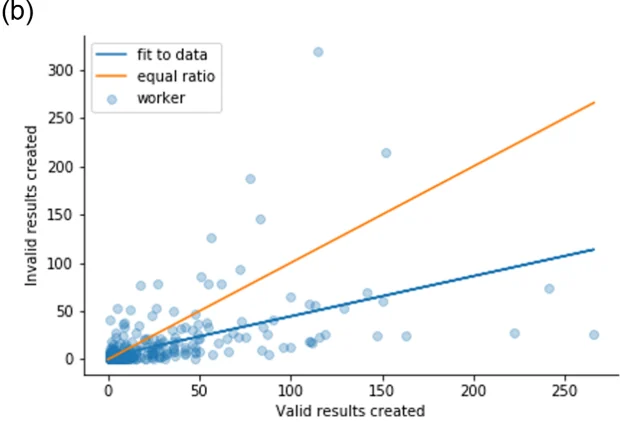
Rework is the cost of work that fails review. In a crowdsourced study measuring airways on chest CT, Cheplygina and colleagues paid $0.10 per task of ten images and classified 57.2% of 20,520 results as invalid before comparing anything with experts. The price per result was low; the price per usable result was more than double it, before counting the effort of building the filters. Even after combining, the authors judged the crowd capable of “good-quality, but not expert-quality” results.
When a quote arrives, make each multiplier explicit:
- Redundancy: one pass is common for boxes on clear objects; subjective labels often need three or more, plus adjudication.
- Review rate: full review or a sample, by whom, and at what fraction of annotation time.
- Rework: who pays when a batch fails acceptance, and whether rejected items are billed twice.
- Gold items: how many known-answer items are mixed in to monitor quality, and whether you pay for them.
- Guideline changes: whether relabelling after a definition changes counts as a new order; a complete guideline written up front, such as one built from our annotation guidelines template, makes them rarer.
Expert labels and model assistance
Expert work changes the arithmetic twice: the hourly rate is higher, and each label takes longer because each decision is harder. No public price list exists for radiologists, lawyers or senior engineers labelling data. Rates are negotiated per project, which makes the cost model more useful, not less.
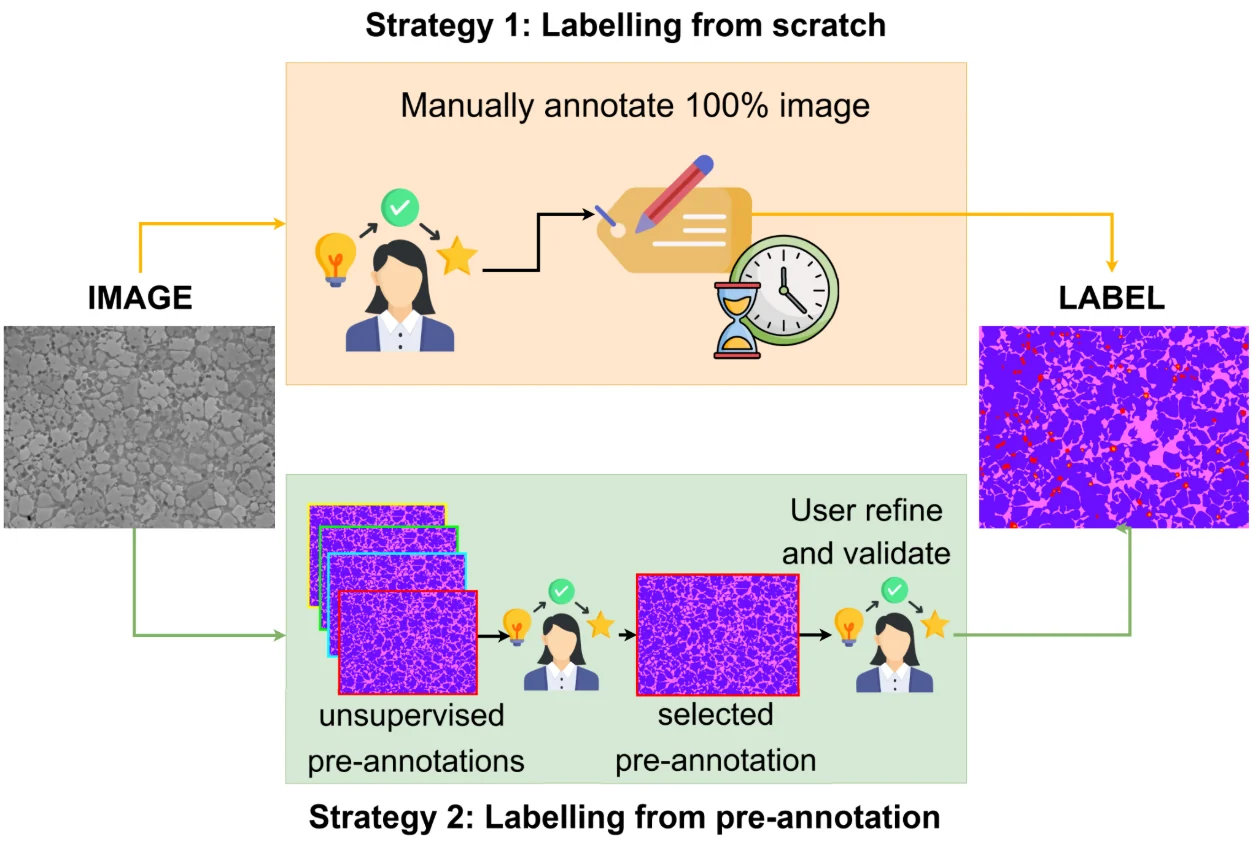
Model assistance is now the main lever on expert time. Fernández-Moreno and colleagues had three materials-science experts segment steel micrographs in Labelbox twice, once from scratch and once by correcting automatic pre-annotations, with the platform recording the time. Median time per image fell from 102–128 minutes to 20–35 minutes, depending on the steel type, and the total from about 170 hours to 37. The general-purpose results in the timing table point the same way, for masks and for video.
Pre-labelling also shifts risk inside a per-label contract. If a vendor runs a model and annotators correct it, the time per label falls, and a price agreed on manual timings becomes generous. If the corrections are rushed, the model’s errors become your labels. Ask whether pre-labels are used, which model produced them, and how often reviewers reject a pre-label rather than accept it.
For preference pairs and other LLM data the unit is a judgement, not a shape, and the time per item depends on response length and domain. There is no public timing benchmark worth quoting. Measure reading and decision time in a pilot, and price redundancy explicitly, because two people comparing long answers disagree far more often than two people drawing a box around a car.
A worked example, with every assumption stated
Take 10,000 street images with an average of six objects each: 60,000 bounding boxes. Assume 5 seconds per image to load and scan it, one pass per object, review at 20% of annotation time, 5% rework, 10% for project management, and a loaded rate of $10 an hour, Labelbox’s published “starting at” figure, used here only as an anchor. Every one of those numbers should be replaced by your own pilot measurement.
At an assumed 10 seconds per box, annotation alone takes 180.6 hours; with review, rework and management the project needs 248 hours, about $2,480, or $0.04 per box and $0.25 per image. The table shows how far the same project moves when only the seconds per label change. A higher rate scales everything linearly: at $25 an hour the 10-second version costs about $6,200.
Two conclusions follow. The time per label moves the total more than the hourly rate does, so a timed pilot is worth more than a discount. And a quote far below the arithmetic is not a bargain: it implies faster labelling than the research measured, less review, or pay that the people doing the work would not accept. You can run your own figures through our annotation cost estimator.
| Scenario (60,000 labels) | Seconds per label | Total hours | Cost at $10/h | Per label |
|---|---|---|---|---|
| Boxes, extreme clicking | 7 | 180 | $1,800 | $0.03 |
| Boxes, assumed typical | 10 | 248 | $2,480 | $0.04 |
| Boxes, high quality (ILSVRC) | 35 | 821 | $8,210 | $0.14 |
| Masks, model-assisted | 14 | 340 | $3,400 | $0.06 |
| Polygons, COCO-style | 79 | 1,830 | $18,300 | $0.30 |
Questions people ask
How much does it cost to label an image?
It depends on what is drawn on it. With the timings above, review and management included, and a $10 hourly rate, six simple boxes cost about $0.25 per image and six COCO-style polygons about $1.80. A fine pixel-level street scene, at more than 1.5 hours per image in Cityscapes, comes to about $20 or more at the same rate. Time a pilot of 50 to 100 of your own images before trusting any per-image figure.
Is per-label or per-hour pricing better?
Neither is cheaper by nature; they place the risk differently. Per-label pricing protects you from slow annotators but invites a margin for uncertainty and disputes over what counts as a unit. Per-hour pricing is fairer while guidelines are still changing, but you need to see productivity. A common pattern is hourly billing for a pilot, then a per-label price once the time per item is measured.
What factors determine data annotation costs?
Seconds per label, which depend on annotation type, objects per item, ambiguity and domain expertise; the loaded hourly rate of whoever labels; redundancy, the number of people per item; review and rework; and project management. Model pre-labelling can cut the time per label sharply, as SAM and expert segmentation studies show, but only if corrections are checked. Data security requirements also narrow the workforce you can use.
Is low-cost data annotation always better?
No. A low price per task can hide a high price per usable label. In one crowdsourced medical study, 57.2% of results were invalid, which more than doubled the effective cost before any expert comparison. Low quotes usually assume fast labelling, thin review or low pay. Compare offers on cost per accepted label at an agreed quality level, measured on the same gold items.
How do I compare quotes from different vendors?
Give every vendor the same pilot batch and the same gold items, then ask each for the seconds per label the quote assumes, the redundancy, the review rate, who pays for rework, whether model pre-labels are used, and the acceptance test. Rebuild each quote with the cost model above. Differences that survive that exercise are real; the rest is packaging.