If you arrived here looking for torchtune's dataset format, the important thing first: the project is no longer actively maintained. Its own README states that development wound down in 2025. This is a migration note rather than a how-to.
The status, plainly
torchtune was Meta's native-PyTorch fine-tuning library — BSD licensed, deliberately dependency-light, built around hackable training recipes for SFT, knowledge distillation, DPO, PPO, GRPO and quantisation-aware training.
Its README now carries a wind-down notice stating that the project is no longer actively maintained, and its last release predates this writing by well over a year. The code remains available and will keep working against the versions it was built for.
That is a reason not to start new work on it. An unmaintained training library drifts out of compatibility with the model architectures, tokenizers and CUDA versions around it, and the drift is silent until something you need does not load.
What it was good at, and where that quality now lives
torchtune's appeal was transparency. The recipes were readable PyTorch rather than a configuration abstraction, which made it the natural choice if you wanted to understand or modify the training loop rather than configure it. It had very few dependencies, which made it pleasant in constrained environments.
Nothing else occupies exactly that niche. The closest in spirit is writing directly against TRL and PEFT yourself — you keep full control of the loop and the dataset handling, at the cost of the convenience torchtune's recipes provided. If what you valued was hackability, that is the honest replacement.
If what you actually valued was that it worked without much ceremony, the wrappers are a better destination.
Choosing a destination
The three actively maintained wrappers differ mainly in ergonomics. All use PEFT for adapters and TRL for preference and RL stages, and all read the common messages and Alpaca shapes, but each has its own data-loading layer. Those shared shapes are what make migration tractable.
| If you valued... | Move to | Because |
|---|---|---|
| Readable, modifiable training loops | TRL + PEFT directly | no wrapper layer, you own the loop and the dataset handling |
| Single-GPU speed and low VRAM | Unsloth | Triton kernels and manual backward passes; fits small GPUs |
| Config-driven runs and irregular data | Axolotl | YAML configs, key remapping, pre-tokenised and template-free formats |
| Multi-GPU and multi-node training | Axolotl | FSDP, DeepSpeed, context and expert parallelism |
| No code at all | LLaMA-Factory | CLI plus a web UI over a wide range of model families |
What the migration actually involves
Less than you might fear on the data side, and more on the configuration side.
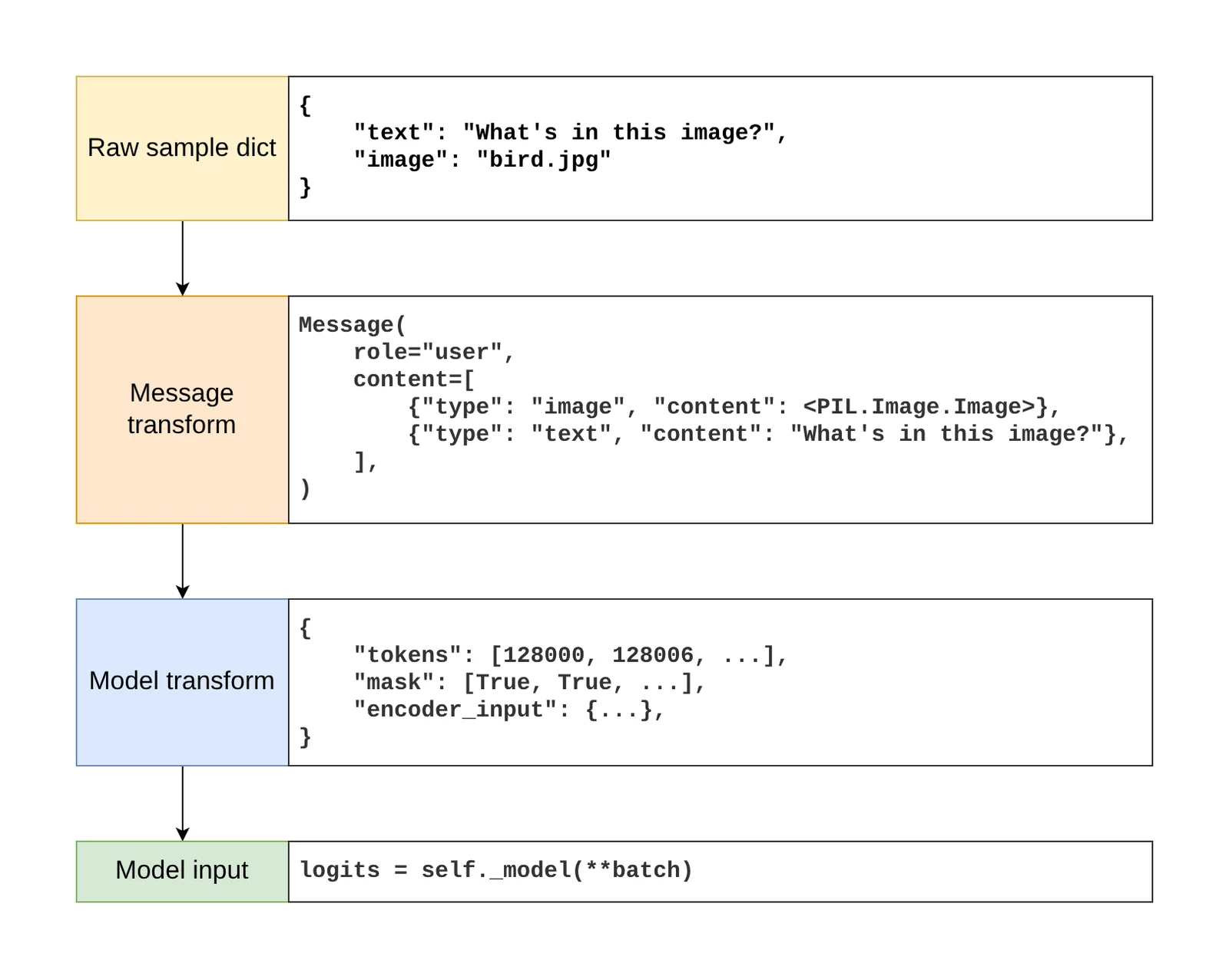
Your datasets are probably fine. torchtune consumed instruction and chat data in the same broad shapes the rest of the ecosystem uses, and the destination frameworks all read a messages list of {role, content} or an Alpaca-style flat row. If your data is in one of those, it transfers unchanged — and Axolotl and LLaMA-Factory can remap unusual field names in configuration rather than requiring a rewrite.
What does not transfer is the recipe configuration: your hyperparameters, masking setup and distributed settings all need re-expressing in the new tool's idiom. Budget for re-validating rather than re-collecting — run your existing evaluation set against a checkpoint trained in the new framework before you trust the numbers, because small differences in template application and loss masking do change results.
Questions people ask
Is torchtune broken?
No. Unmaintained is not the same as broken — pinned to the dependency versions it was built against, it does what it always did. The risk is forward-looking: new model architectures, tokenizer changes and CUDA updates will not be accommodated, so the set of things you can train with it stops growing.
Can I still read its recipes to learn how fine-tuning works?
Yes, and that is arguably its best remaining use. The recipes are clear, deliberately unabstracted PyTorch, and the mechanics they illustrate — loss masking, distillation, preference optimisation — have not changed. Just do not copy version-specific API calls into new code.
Which replacement has the most similar dataset handling?
TRL directly — writing a formatting function for SFTTrainer is closest to writing your own torchtune transforms, and you keep the same degree of control.
Does this affect PyTorch itself?
Not at all. This is one library in the ecosystem winding down, not a change to PyTorch, which remains the substrate under every alternative listed here.