World models are the most-discussed and least-documented area of Physical AI. Here is what each programme actually publishes about its training data — and the gaps are as informative as the numbers.
What a world model is
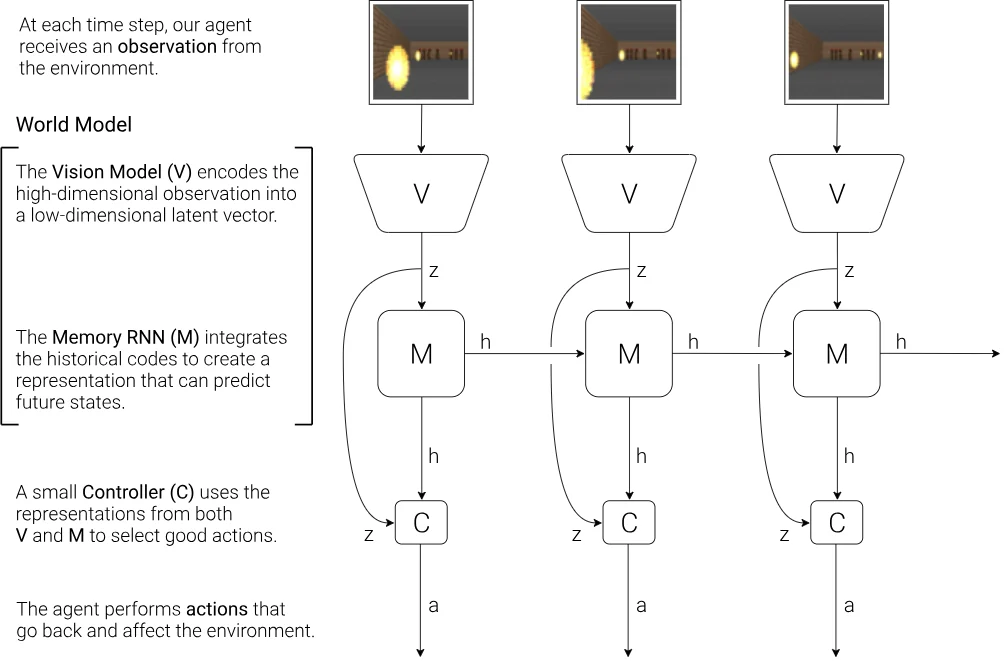
The Cosmos paper gives the usable definition: a world foundation model is “a digital twin of the physical world that a Physical AI can safely interact with” — formally, a model that “predicts the future observation at time t+1” given past observations and the current perturbation.
The appeal for robotics is obvious. If you can predict what happens next, you can plan without acting, generate training scenarios without collecting them, and evaluate a policy without risking hardware. That is why every major lab has a programme.
The data these models need is video at enormous scale, often paired with action or control signals. Which is where the publishing gets thin.
What each programme publishes
Compiled from each programme's own primary source. 'Not published' means the source does not state it, which is a finding rather than an omission on our part.
| Programme | Training data as published | Availability |
|---|---|---|
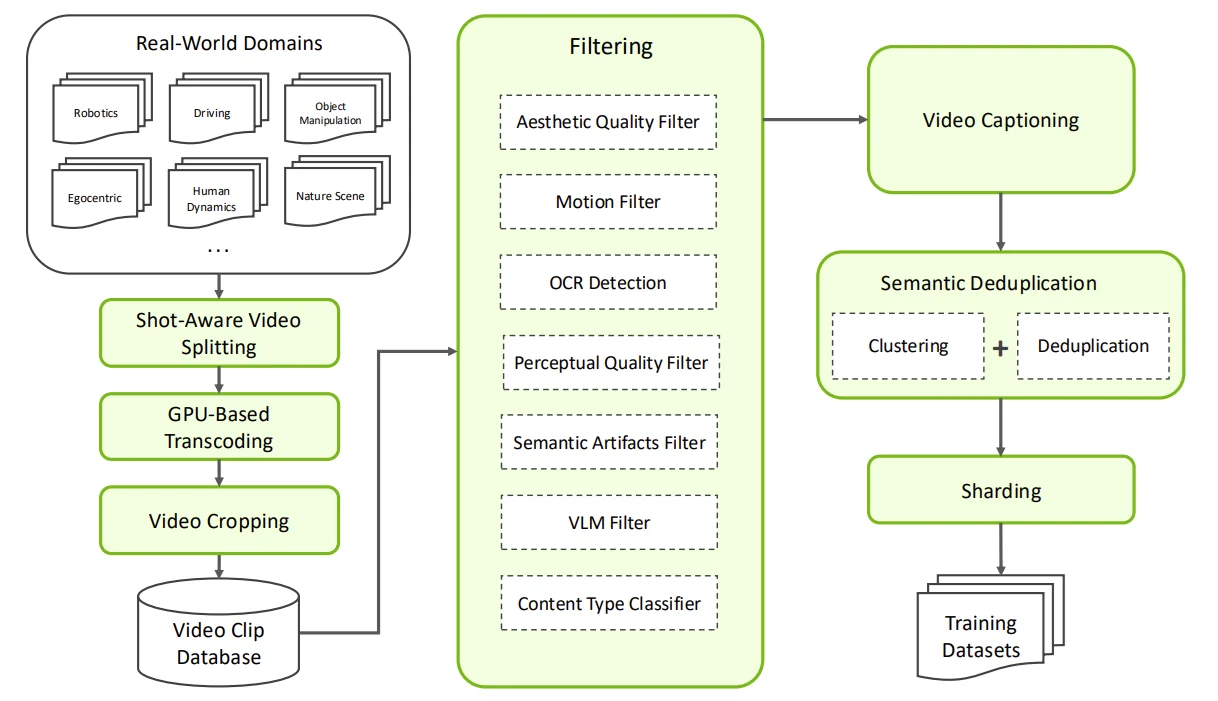
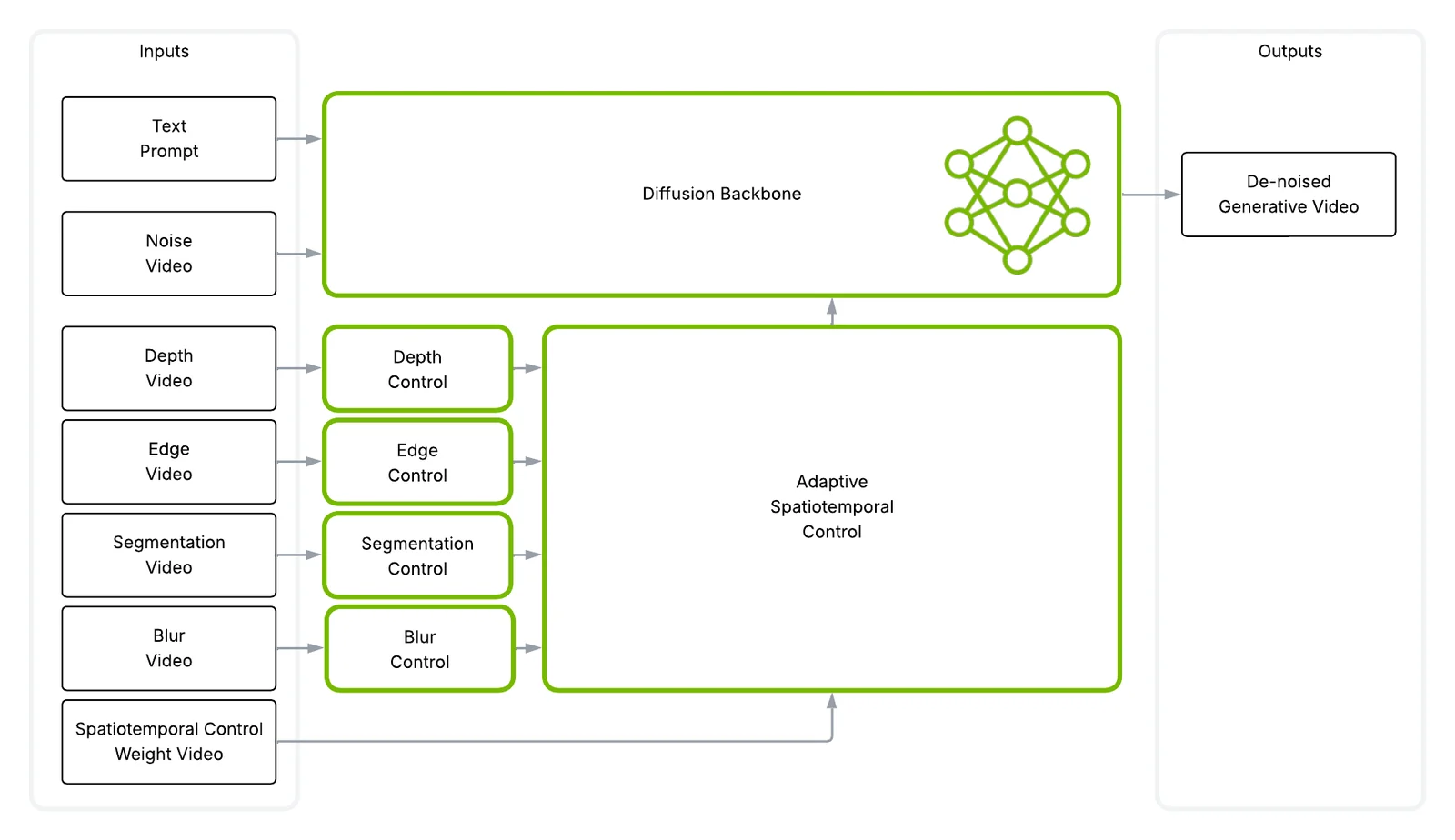
| Cosmos (WFM 1) | a 20M hour video pool curated to ~100M clips of 2–60 seconds; content-category mix published (e.g. nature dynamics 20%, hand motion and object manipulation 16%); NVIDIA's launch blog cites 9,000 trillion training tokens | models under NVIDIA Open Model License |
| Cosmos Predict 2.5 | “trained on 200M curated video clips”; Transfer 2.5's own data not published | weights on Hugging Face; repo now in limited maintenance, superseded by Cosmos 3 |
| Cosmos 3 | no hours or clip count; NVIDIA says only billions of samples across text, image, video, sound and action trajectories | Super and Nano weights on Hugging Face since May 2026 |
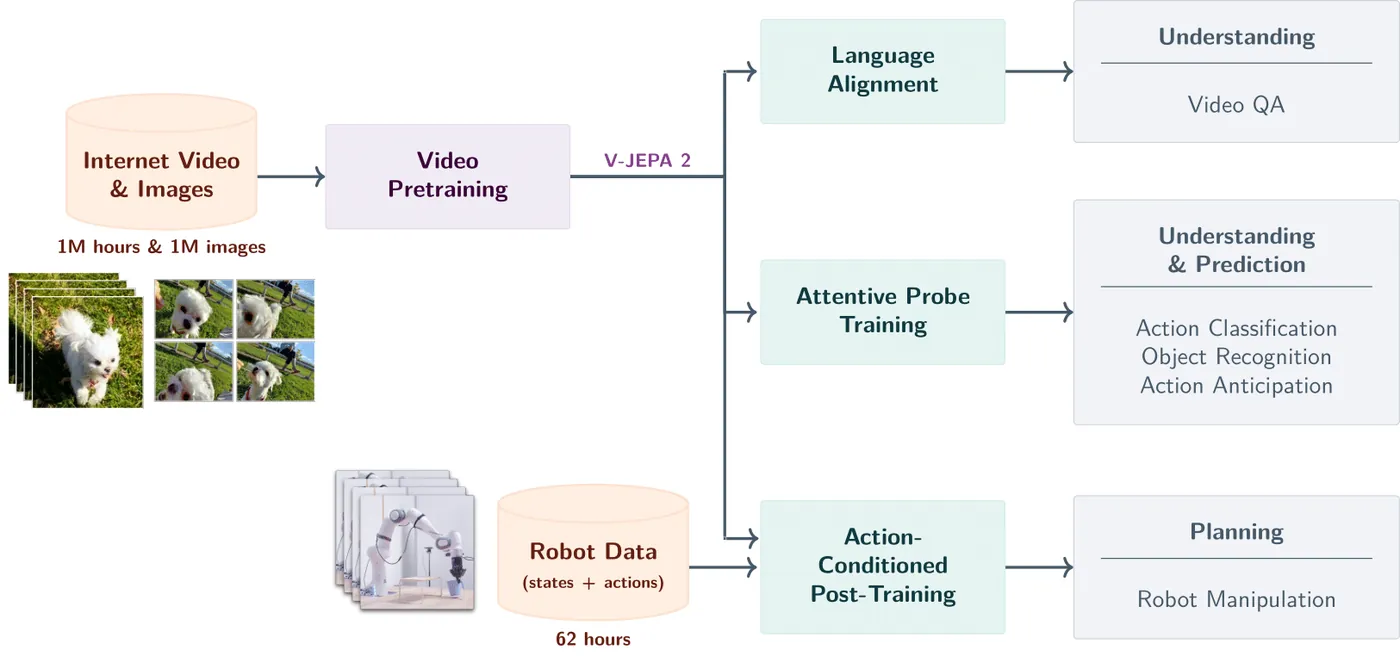
| V-JEPA 2 | “over 1 million hours of internet video”; action post-training on “less than 62 hours” of DROID video | weights released by Meta |
| Genie | pool of “over 200,000 hours” of gaming video; filtered training set 6.8M clips / ~30k hours; 11B parameters | no weights, no data |
| Genie 2 | no data or resolution figures — only “a large-scale video dataset”; consistent worlds “for up to a minute” | no release |
| Genie 3 | training data not published; 720p, 24fps, consistency over “a few minutes” | no weights; Project Genie prototype for Google AI Ultra subscribers since January 2026 (US first) |
| Genie 4 | training data not published; announced late October 2026, after this post was first published | research preview for trusted testers; Project Genie access announced as coming soon |
| AgiBot Genie Envisioner | ~3,000 hours / ~1M episodes, entirely from AgiBot-World-Beta | GE-Base weights on Hugging Face under the LTX-Video 2B v0.9 licence; other code and data CC BY-NC-SA 4.0 |
| 1X World Model | no exact figure — “thousands of hours of data on EVE humanoids”; over 100 hours released for its World Model Challenge | over 100 hours of tokenised video (Apache 2.0) and baseline model weights released |
The Genie figure everyone misreports
Genie is a good cautionary example of reading a paper rather than its coverage.
The source pool is “over 200,000 hours of publicly available Internet gaming videos”, with the unfiltered set given as around 244k hours and 55M videos. But the actual training set is “6.8M 16s video clips (30k hours)” — “our final dataset is 6.8M videos for a total of over 30k hours.”
Those are different pipeline stages: 200k+ hours collected, 30k hours trained on. Press coverage routinely conflates them and reports the larger number as the training set. The model is 11B parameters, of which the paper itemises 10.1B as the dynamics model, with a latent action vocabulary of just 8.
The lesson generalises: in this literature, always check whether a published hours figure is the pool, the filtered set, or the set actually trained on.
V-JEPA 2's striking result
V-JEPA 2 publishes the most useful number in this whole area for anyone doing robotics.
It pretrains on over a million hours of internet video. Then, to produce an action-conditioned model capable of robot control, it post-trains on “less than 62 hours of unlabeled robot videos from the Droid dataset”.
Sixty-two hours. And the resulting model was deployed on Franka arms in two labs with no robot data collected in either, performing pick-and-place by planning to image goals “without any task-specific training or reward.”
Its benchmark figures: Something-Something v2 77.3 top-1, Epic-Kitchens-100 action anticipation 39.7 recall-at-5, PerceptionTest 84.0, TempCompass 76.9.
If that approach holds up, it reframes the data problem substantially: the expensive scarce resource becomes passive video, which is abundant, rather than teleoperation, which is not.
What this means practically
Three conclusions worth carrying away.
You are not going to train one of these. Cosmos's 100M clips and V-JEPA 2's million hours are industrial-scale efforts. The realistic engagement is fine-tuning or conditioning a released model — Cosmos and V-JEPA 2 have released weights, DeepMind's Genie models have not.
Check the licence on released weights. Cosmos ships under NVIDIA's own Open Model License rather than a standard open-source licence, which has its own terms to read.
The data asymmetry is a real signal. When a programme publishes clip counts and curation pipelines, you can assess it. When it publishes capability demos and nothing about inputs, you are evaluating a product rather than a result. Both can be useful; they warrant different levels of confidence.
Questions people ask
Can I use a world model to generate robot training data?
That is one of the stated motivations, and Cosmos is positioned for it. The practical caveat is that a policy trained on generated rollouts inherits the generator's physical inaccuracies, so the sim-to-real gap becomes a model-to-real gap. Treat generated data as augmentation around real data rather than as a replacement for it.
What is the difference between a world model and a video generator?
Action conditioning. A video generator produces plausible video from a prompt; a world model predicts the next observation given a specific action or perturbation, which is what makes it usable for planning. The architectures overlap heavily and the labels are applied loosely in marketing.
Why do these need so much more data than language models?
Video is far denser per sample and the models must learn physical dynamics rather than symbolic structure — and crucially there is no equivalent of the instruction-tuning shortcut, where a thousand examples select among existing behaviours. V-JEPA 2's 62-hour action post-training is notable precisely because it looks like such a shortcut.
Which released world model should I start from?
Of those with public weights, Cosmos is the one explicitly built for Physical AI and has variants for different conditioning modes. V-JEPA 2 is the stronger choice if you want a representation for downstream control and planning rather than generation. Read both licences before committing.