Audio splits cleanly into four jobs: transcribe it, classify it, identify who is speaking, or read the emotion. Picking the wrong corpus for the job costs more time than any architecture choice.
LibriSpeech is the benchmark everyone reports, but it is read audiobook speech — clean, segmented and nothing like a phone call. GigaSpeech and Common Voice are the corrective.
Five of the nine are non-commercial, gated or both: GigaSpeech's audio, UrbanSound8K, ESC-50, RAVDESS and VoxCeleb. Check before you build a product on them.
| Dataset | Modality | Size | Licence | Best for |
|---|---|---|---|---|
| Mozilla Common Voice | Audio | 42,600 hours | CC0 | Multilingual ASR |
| LibriSpeech | Audio | ~1,000 hours | CC BY 4.0 | ASR benchmark |
| GigaSpeech | Audio | Up to 10,000 hours | Research only | Scale ASR |
| Google Speech Commands | Audio | ~105,000 clips | CC BY 4.0 | Keyword spotting |
| AudioSet | Audio | 2M+ annotated clips | CC BY 4.0 (labels only) | Sound events |
| UrbanSound8K | Audio | 8,732 clips | CC BY-NC 4.0 | Urban noise |
| ESC-50 | Audio | 2,000 five-second clips | CC BY-NC | Few-shot audio |
| RAVDESS | Multimodal | 7,356 files | CC BY-NC-SA 4.0 | Emotion recognition |
| VoxCeleb | Audio | 1M+ clips | Gated access | Speaker ID |
Mozilla Common Voice
- Size
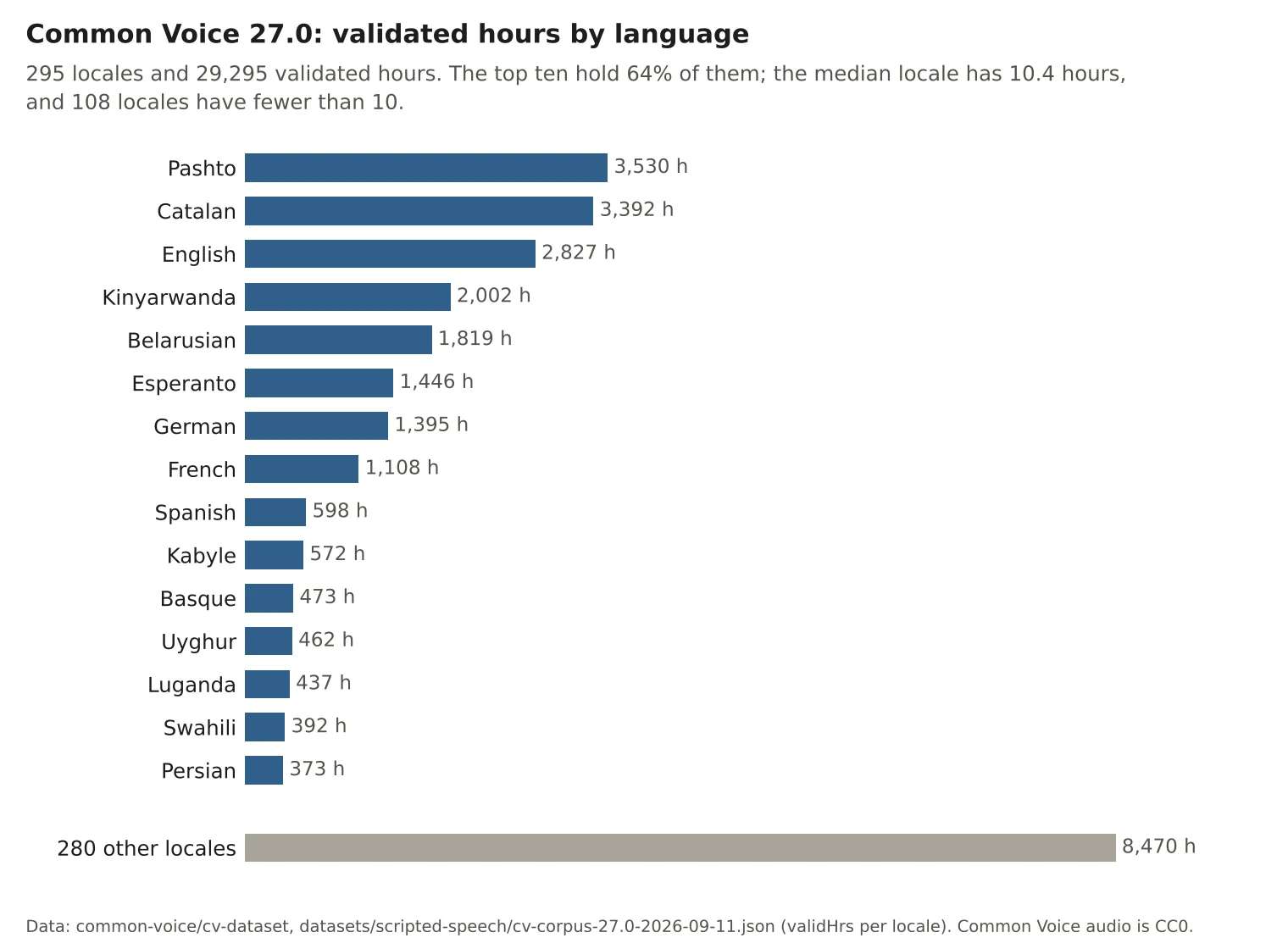
- ~42,600 recorded hours (29,300 validated), 295 languages
- Licence
- CC0 1.0
Mozilla's crowdsourced speech corpus: tens of thousands of hours of MP3 clips with TSV metadata, about 42,600 recorded and 29,300 validated hours across 295 languages in release 27.0 (data collected to September 2026). Contributors read sentences aloud in their own accents and recording conditions, which is why models trained on it survive contact with real microphones.
Multilingual speech recognition, and accent-robustness testing for an ASR model trained on cleaner data.
Source: innovatiana.com/datasets
LibriSpeech
- Size
- ~1,000 hours
- Licence
- CC BY 4.0
About 1,000 hours of read audiobook speech in FLAC with TXT transcripts. Clean, well-segmented and the default benchmark for English ASR — if you report word error rate, this is the number people expect to see.
English ASR training and the baseline WER figure every reviewer will ask for.
Source: innovatiana.com/datasets
GigaSpeech
- Size
- Up to 10,000 hours
- Licence
- Apache 2.0 for metadata and code; the audio is gated and for non-commercial research and education only
Up to 10,000 hours of transcribed audio in WAV and Opus, drawn from audiobooks, podcasts and YouTube. An order of magnitude more than LibriSpeech, and far messier — which is the point if your model has to handle spontaneous speech. SpeechColab does not own the audio copyright, so downloading the audio means agreeing to its non-commercial research and education terms.
Large-scale ASR pre-training where spontaneous, noisy speech is the target domain. Access is gated, and the audio terms are non-commercial.
Source: innovatiana.com/datasets
| filename | fold | target | category | esc10 | src_file | take |
|---|---|---|---|---|---|---|
| 1-100032-A-0.wav | 1 | 0 | dog | True | 100032 | A |
| 1-172649-A-40.wav | 1 | 40 | helicopter | True | 172649 | A |
| 1-17367-A-10.wav | 1 | 10 | rain | True | 17367 | A |
Google Speech Commands
- Size
- ~105,000 clips
- Licence
- CC BY 4.0
Around 105,000 one-second WAV clips of single spoken words. Built for wake-word and command recognition on constrained hardware, so the clips are short, the vocabulary is small and the models that win are tiny.
Keyword spotting and on-device voice commands where latency and model size matter more than vocabulary.
Source: innovatiana.com/datasets
AudioSet
- Size
- 2M+ annotated clips
- Licence
- CC BY 4.0 for the labels (the ontology is CC BY-SA 4.0); the audio stays on YouTube under its owners' rights
Over two million annotated audio clips across a large ontology of sound events, released by Google. The labels are CC BY 4.0 but the audio itself stays on YouTube, so ingestion is a real engineering step rather than a download.
General audio event detection and tagging — the closest thing the field has to ImageNet for sound.
Source: innovatiana.com/datasets
UrbanSound8K
- Size
- 8,732 clips
- Licence
- CC BY-NC 4.0 (Zenodo download; the project site cites 3.0)
8,732 WAV clips of urban sounds — sirens, drilling, dogs, street music — organised into ten classes with a pre-defined ten-fold split. Use the published folds; results computed on a random split are not comparable to anything.
Environmental sound classification and urban acoustic-scene work. Non-commercial licence, so keep it to research.
Source: innovatiana.com/datasets
ESC-50
- Size
- 2,000 five-second clips
- Licence
- CC BY-NC
2,000 five-second clips across 50 environmental classes — exactly 40 examples per class. The deliberate scarcity makes it the standard testbed for few-shot and transfer approaches in audio.
Few-shot audio classification. Non-commercial licence, so keep it to research.
Source: innovatiana.com/datasets
RAVDESS
- Size
- 7,356 files
- Licence
- CC BY-NC-SA 4.0
7,356 WAV and MP4 files of actors speaking and singing in a controlled set of emotional states. Acted rather than spontaneous, which makes the labels clean and the generalisation to real emotion an open question worth measuring.
Speech emotion recognition, and audio-visual fusion since both modalities are aligned. Non-commercial and share-alike.
Source: innovatiana.com/datasets
VoxCeleb
- Size
- 1M+ clips
- Licence
- CC BY 4.0 · request access
Over a million clips of human speech collected from interview footage, covering thousands of speakers in uncontrolled conditions. Speaker identity rather than content is the label, and the background noise is a feature, not a flaw.
Speaker identification and verification. The audio-visual files are released on request. The dataset is CC BY 4.0, offered for research purposes, but copyright in the underlying videos stays with their original owners, so clear any commercial use separately.
Source: innovatiana.com/datasets
How this list was put together
Every entry is drawn from Innovatiana's open-dataset catalogue and links back to its page, where the full licence text and size string are published.
Hour counts and clip counts are quoted as published; where a corpus spans multiple subsets, the figure is the whole collection.