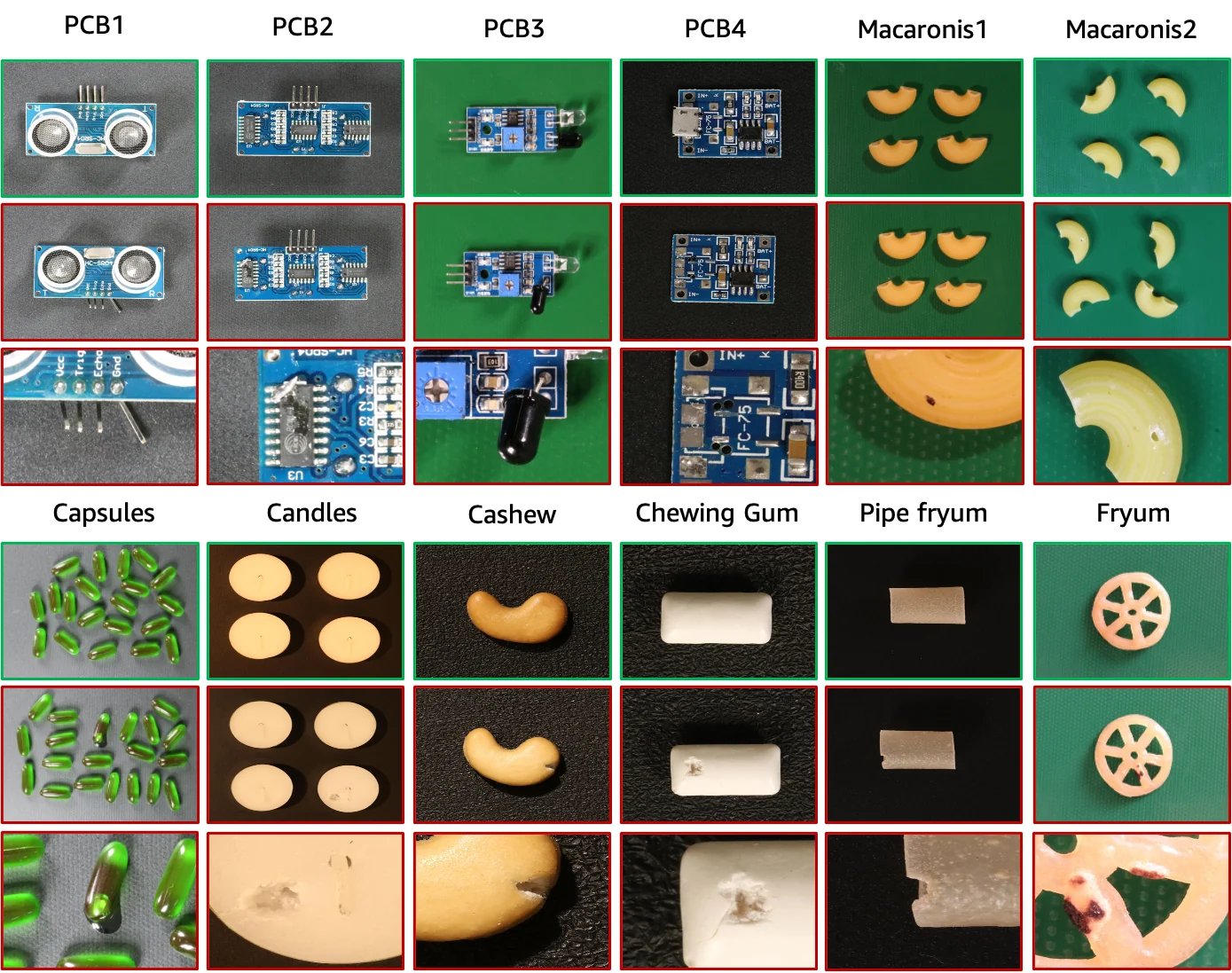
Industrial vision has a defining property that shapes every dataset in it: defects are rare, so you almost never have balanced classes, and the right method follows from that.
The class-imbalance problem is structural rather than a sampling artefact. A production line running well produces overwhelmingly good parts, so a dataset collected honestly has very few defects, and a classifier trained on it learns to say 'fine' and be right most of the time. That is why anomaly detection — modelling what normal looks like and flagging deviation — often outperforms supervised classification here, and needs far fewer defect examples.
The second feature is how specific the data is. A surface defect on one alloy under one lighting rig looks nothing like the same defect class elsewhere, so transfer between industrial datasets is poorer than in most vision domains. Public sets are best used to establish a method and a baseline; the deployed model almost always needs images from your own line, which for a few hundred annotated defects is usually a tractable collection job.
| Dataset | Modality | Size | Licence | Best for |
|---|---|---|---|---|
| Structural Defects Network - Images of cracks in concrete | Image | 56,000 images | CC BY 4.0 | Automated visual inspection of civil infrastructure |
| Bridge Cracks Image Dataset | Image | 61,000 images | Non-commercial | AI to find cracks |
| Road Damage Detection Dataset | Image | 4,018 files | MIT | Automatic detection of road damage |
| Pothole Image Segmentation Dataset | Image | 780 images | Apache 2.0 | Pothole segmentation models |
| Pothole Detection Dataset | Image | 681 images | CC0 | Classification of road irregularities |
| Safety Helmet Detection for Construction Sites | Image | 19,700 images | CC BY 4.0 | Automating helmet detection |
| Construction Site Safety Image Dataset | Image | 5,641 images | CC BY 4.0 | Spot protective gear in real time |
| Garbage Classification V2 | Image | 19,762 images | MIT | Image classification to identify waste types |
| Garbage Detection Dataset | Image | 20,900 files | CC BY 4.0 | Object detection to sort waste automatically |
| New Trash Classification Dataset | Image | 8,000 images | CC BY 4.0 | Image classification in an environmental context |
| Visual Plastic Type Recognition Dataset | Image | 3,000 images | CC BY 4.0 | Image classification to recognise different plastics |
| Plastic Paper Garbage Bag Synthetic Images | Image | 30,000 images | CC BY-SA 4.0 | CNNs to classify and segment objects |
Structural Defects Network - Images of cracks in concrete
- Size
- 56,000+ images segmented into 256×256 px sub-images, JPEG/PNG format
- Licence
- CC BY 4.0 (Utah State University's SDNET2018 release)
More than 56,000 images of concrete surfaces from bridges, walls and roads, segmented into 256x256 pixel sub-images in JPEG and PNG and labelled cracked or uncracked. Known as SDNET2018, which Utah State University publishes under CC BY 4.0, so attribution is required.
Developing automated visual inspection of civil infrastructure, training early structural defect detection, and comparing image analysis techniques for structural monitoring.
Source: innovatiana.com
Bridge Cracks Image Dataset
- Size
- Over 61,000 image files in various formats
- Licence
- Non-commercial use only, per the authors' README (the catalogue card says open)
Over 61,000 labelled images for finding fractures in bridge structures, in assorted formats, accompanied by scientific papers dating from 2017 onwards. One of the largest openly available infrastructure crack sets.
Training AI to find cracks in infrastructure automatically, building predictive maintenance for bridges, and academic research in structural health monitoring.
Source: innovatiana.com
Road Damage Detection Dataset
- Size
- 4,018 files: 2,000+ road images and their detection annotations
- Licence
- MIT
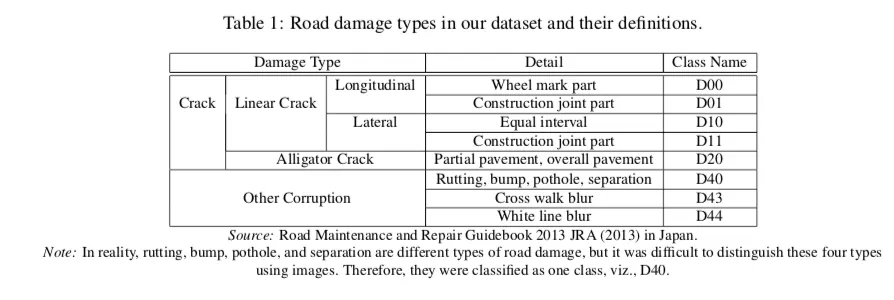
More than 2,000 road images (4,018 files with their annotations) with bounding boxes marking potholes, cracks and manholes. It is labelled MIT, and its author says he took the images himself, with a GoPro on a moving vehicle and a smartphone, around Rome and Sacrofano in Italy.
Automatic detection of road damage, optimising urban maintenance with vehicle or drone sensors, and tools for road operators.
Source: innovatiana.com
Pothole Image Segmentation Dataset
- Size
- 780 annotated images in YOLOv8 format, 640x640 px, with sets train (720) and validation (60)
- Licence
- Apache 2.0
780 augmented road images resized to 640x640 and annotated in YOLOv8 segmentation format, split 720 train and 60 validation. Tiny but segmentation-ready, with a permissive Apache licence for commercial use.
Training pothole segmentation models, developing automatic road monitoring and maintenance, and improving safety through damage detection.
Source: innovatiana.com
Pothole Detection Dataset
- Size
- 681 JPG images divided into two classes: normal roads and roads with potholes
- Licence
- CC0: Public Domain
681 JPG road photographs split into two classes, normal roads and roads containing potholes. Very small and classification-only, so best treated as a demonstration or fine-tuning set rather than a training corpus.
Training classification of road irregularities, creating embedded surveillance for autonomous vehicles or drones, and developing urban maintenance tools.
Source: innovatiana.com
Safety Helmet Detection for Construction Sites
- Size
- Approximately 19,700 annotated images, annotations in YOLOv5 format
- Licence
- Attribution 4.0 International (CC BY 4.0)
About 19,700 labelled construction site photographs with YOLOv5-format annotations for workers' protective helmets. Large enough for production-grade PPE detection and openly licensed for commercial deployment.
Automating helmet detection to improve site safety, improving regulatory oversight at industrial sites, and developing industrial object detection systems.
Source: innovatiana.com
Construction Site Safety Image Dataset
- Size
- 5,641 annotated images, JPEG/PNG formats, 14 annotation columns including PPE types and positions
- Licence
- CC BY 4.0
5,641 labelled JPEG and PNG photographs of workers on building sites, with 14 annotation columns covering protective equipment types such as helmets and vests plus their positions. Broader PPE coverage than helmet-only sets.
Training models to spot protective gear in real time, checking safety-rule compliance on sites, and reducing accidents through better safety management.
Source: innovatiana.com
Garbage Classification V2
- Size
- Approximately 19,762 images divided into 10 classes, JPEG/PNG formats
- Licence
- MIT
Nearly 20,000 waste photographs in JPEG and PNG across ten categories, for building recycling-focused vision models. MIT licensing and a ten-class taxonomy make it the most production-ready of the waste sets here.
Training image classification to identify waste types, developing AI for automated recycling sorting, and testing computer vision applied to waste management.
Source: innovatiana.com
Garbage Detection Dataset
- Size
- Around 20,900 files (JPG images + TXT labels), organized by train/valid/test
- Licence
- Attribution 4.0 International (CC BY 4.0)
Around 20,900 files of JPG images with TXT labels compatible with YOLOv5, pre-organised into train, validation and test folders, covering six waste-sorting object categories. Detection rather than whole-image classification.
Training object detection to sort waste automatically, developing real-time intelligent sorting and recycling systems, and improving YOLO and other vision methods.
Source: innovatiana.com
New Trash Classification Dataset
- Size
- 8,000 JPG images divided into 8 classes
- Licence
- CC BY 4.0
8,000 JPG images evenly spread across eight waste categories, balanced by design so classifiers are not skewed by class frequency. A smaller, cleaner alternative to the larger garbage sets.
Training image classification in an environmental context, AI projects to sort recyclable waste automatically, and mobile or industrial selective sorting applications.
Source: innovatiana.com
Visual Plastic Type Recognition Dataset
- Size
- Over 3,000 JPEG images arranged in 6 folders (PET, PE, PC, PP, PS, Others)
- Licence
- Creative Commons Attribution 4.0 International (CC BY 4.0)
Over 3,000 real JPEG photographs grouped into six folders by polymer type: PET, PE, PC, PP, PS and Others. Polymer-level rather than generic waste classification, which is the harder and more commercially relevant task.
Training image classification to recognise different plastics, improving automatic sorting in recycling chains, and raising awareness of plastic recyclability.
Source: innovatiana.com
Plastic Paper Garbage Bag Synthetic Images
- Size
- Approximately 30,000 synthetic images annotated in COCO format, plastic categories, paper, waste bags
- Licence
- CC BY-SA 4.0
Roughly 30,000 fully synthetic images of plastic bags, paper bags and waste, annotated in COCO format across those categories. Synthetic generation gives perfect labels and unlimited variation of pose and lighting.
Training CNNs to classify and segment objects in environmental settings, building recognition for waste management and recycling, and testing on varied synthetic images.
Source: innovatiana.com
How this list was put together
Drawn from the datasets in Dataset Finder filed under this topic, then checked by hand against what this page covers. A tag is a filing decision, not a description, so records that carried the tag without being about the topic were removed, and relevant records filed elsewhere were added. The order puts the closest fit first.
Sizes and licences come from each dataset's own documentation, vague wording included. Where we found a re-upload or catalogue card stating a licence that the original release contradicts — a CC0 tag on Flickr photographs, MIT on data whose terms require a signed agreement — the entry gives the original terms and says so. The comparison table abbreviates licences; hover a cell for the full wording.