Instruction data is where a base model learns to respond rather than merely continue. These are the open sets, and the licence column is the one to read first if you intend to ship anything.
Two shapes dominate this category and they train different things. Supervised fine-tuning data is one good answer per prompt, and teaches the model how to respond. Preference data is two answers plus an ordering, and teaches it which of two acceptable answers is better. A set of the first kind cannot be used for the second without manufacturing rejected answers, which is harder to do well than it sounds.
Scale in this category is genuinely contested rather than merely variable. Published results exist at a thousand examples and at nearly a million, and both are defensible depending on how many distinct capabilities you need. If you are teaching one behaviour, the smaller end of this list is likely to serve you better than the larger.
| Dataset | Modality | Size | Licence | Best for |
|---|---|---|---|---|
| Reasoning V1 20M | Text | 22M rows | Apache 2.0 | Replicate complex reasoning |
| Ring Lite Distill Preview SFT Data | Text | 2M examples | Apache 2.0 | Language models through supervised learning |
| HQIT - A massive set of tuning instructions from LLM | Text | 1.9M samples | Apache 2.0 | Align with human instructions |
| SFT General Knowledge - LLM training dataset | Text | 1.63M examples | MIT | LLM on varied contextualised responses |
| WebInstruct-CFT | Text | 600,000 examples | Apache 2.0 | Generate accurate constructive criticism |
| OpenCoder SFT Stage 2 | Text | 436,000 examples | MIT | Generate accurate functional Python code |
| SlimOrca Dedup | Text | 363,491 lines | MIT | Large-scale NLP model training |
| WebInstruct Verified | Text | 230,000 questions | Apache 2.0 | General and domain reasoning |
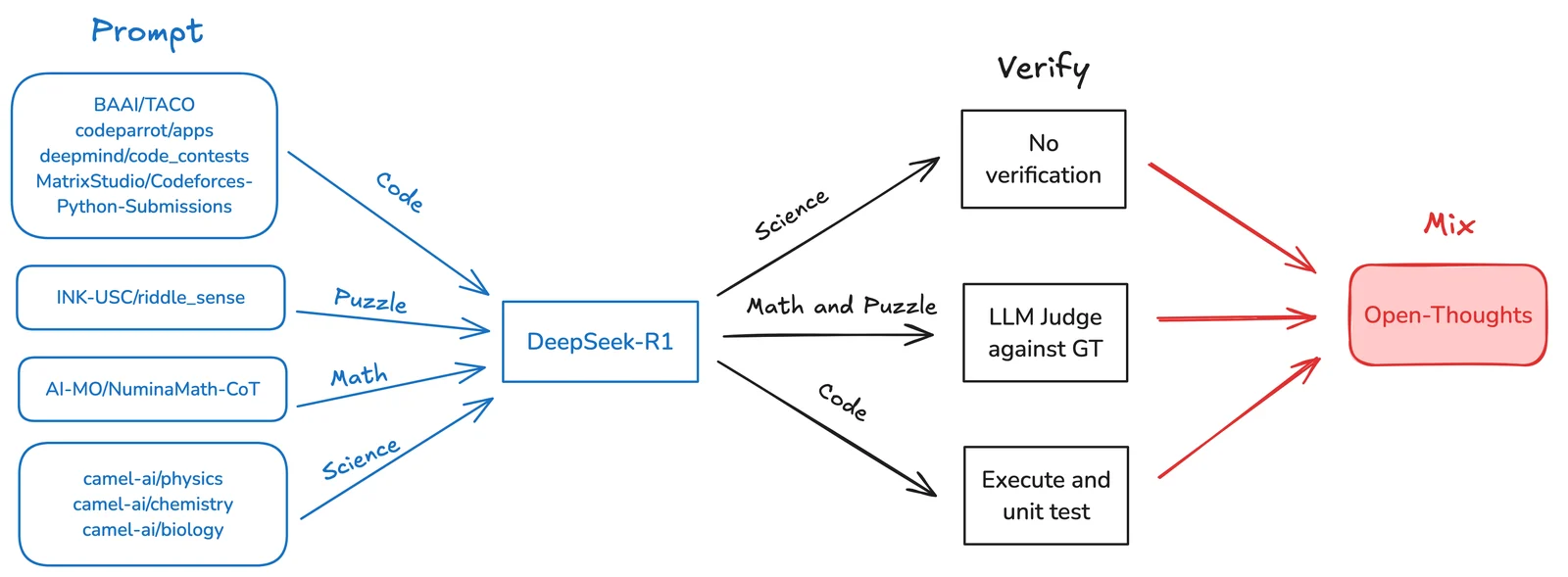
| OpenThoughts 114k | Text | 114,000 examples | Apache 2.0 | Models for multi-stage reasoning |
| Persona-100k | Text | 100,000 entries | Apache 2.0 | Generate profile-adapted responses |
| Cotton67k | Text | 67,844 examples | Apache 2.0 | Explain reasoning step by step |
Reasoning V1 20M
- Size
- Over 22 million rows, 35.8 billion tokens, JSON/parquet format
- Licence
- Apache 2.0
Over 22 million rows and 35.8 billion tokens in JSON and Parquet, pairing questions and answers with written reasoning traces across subjects deliberately excluding mathematics and code. Fills the gap most reasoning sets leave.
Training models to replicate complex reasoning, improving smaller models via supervised fine-tuning with explicit traces, and evaluating step-by-step reasoning.
Source: innovatiana.com
Ring Lite Distill Preview SFT Data
- Size
- Approximately 2 million text examples, structured JSON format
- Licence
- Apache 2.0
About two million structured JSON text examples used for supervised fine-tuning of large language models, released as a preview alongside the Ring-lite distillation work by inclusionAI. Reasoning-focused rather than general: the card describes English and Chinese samples covering mathematics, programming and science.
Refining language models through supervised learning, improving relevance and consistency of generated responses, and testing performance on text generation tasks.
Source: innovatiana.com
HQIT - A massive set of tuning instructions from LLM
- Size
- Approximately 1.9 million samples, JSONL format
- Licence
- Apache 2.0
Roughly 1.9 million JSONL instruction-response pairs framed as textual tasks, simulating natural user-AI interaction. Large enough to serve as a primary instruction-tuning corpus rather than a supplement, under Apache licensing.
Training or refining LLMs to align with human instructions, improving conversational assistants across contexts, and testing robustness on millions of realistic cases.
Source: innovatiana.com
SFT General Knowledge - LLM training dataset
- Size
- 1.63 million examples (2.19 GB), JSON/parquet format
- Licence
- MIT
About 1.63 million instruction-response pairs totalling 2.19 GB in JSON and Parquet, spanning broad general knowledge, prepared specifically for supervised fine-tuning. MIT licensed and immediately trainable.
Training an LLM on varied contextualised responses, fine-tuning for instruction or QA, and evaluating general understanding.
Source: innovatiana.com
WebInstruct-CFT
- Size
- Up to 600,000 examples (versions from 4,000 to 600,000), JSON format with instructions, inputs, text outputs
- Licence
- Apache 2.0
Released in versions from 4,000 up to 600,000 JSON examples holding instructions, inputs and outputs, where model-generated critiques of answers span maths, physics, chemistry, business and humanities. Built for critique-model training.
Fine-tuning LLMs to generate accurate constructive criticism, improving response quality, and training across scientific and business areas.
Source: innovatiana.com
OpenCoder SFT Stage 2
- Size
- About 436,000 examples in four JSON subsets (instruction, code, test case)
- Licence
- MIT
About 436,000 JSON examples across four subsets (the two largest alone hold about 289,000) holding instruction, code and sometimes test cases, drawn from educational data, Python documentation and validated synthetic instructions. The second-stage SFT mix for OpenCoder.
Training models to generate accurate functional Python code, evaluating algorithmic understanding on technical prompts, and improving SFT for development agents.
Source: innovatiana.com
SlimOrca Dedup
- Size
- Approximately 363,491 lines, Parquet format, size 307 MB
- Licence
- MIT
About 363,491 deduplicated instruction-response lines in Parquet at 307 MB, a cleaned derivative of the OpenOrca family. Deduplication is the point: it removes the near-identical samples that inflate the parent corpus.
Large-scale NLP model training, evaluation and benchmarking on cleaned text data, and deduplication and data quality studies.
Source: innovatiana.com
WebInstruct Verified
- Size
- Over 230,000 verified questions and answers, structured text format
- Licence
- Apache 2.0
Over 230,000 web-sourced question-answer pairs in structured text, filtered so that each answer is independently checkable, spanning mathematics, physics, chemistry, finance and the humanities. Verification is the differentiator.
Training general and domain reasoning in language models, testing LLM performance on complex diversified questions, and building contextual validation systems.
Source: innovatiana.com
OpenThoughts 114k
- Size
- 114,000 examples in JSON format (problems, solutions, reasoning, code), data ready to be trained
- Licence
- Apache 2.0
114,000 JSON entries each containing a problem, a reference solution, intermediate reasoning and sometimes code, prepared ready for training. A compact reasoning-distillation set for STEM tasks.
Training models for multi-stage reasoning, building benchmarks for STEM tasks, and improving performance on complex cases through fine-tuning.
Source: innovatiana.com
Persona-100k
- Size
- 100,000 entries in JSONL format (504 MB)
- Licence
- Apache 2.0
100,000 JSONL synthetic personas totalling 504 MB, each carrying over 70 attributes spanning personal data, profession, cultural preferences, lifestyle and personality traits. Synthetic throughout, so no real individuals are described.
Training LLMs to generate profile-adapted responses, evaluating model fairness across simulated demographics, and simulating realistic users in conversational agents.
Source: innovatiana.com
Cotton67k
- Size
- 67,844 examples, 813 MB, JSON/shareGPT format
- Licence
- Apache 2.0
Despite the name, this is CoTton-67k, a conversational reasoning corpus of 67,844 user-model exchanges in JSON and shareGPT format totalling 813 MB, each containing multi-step chain-of-thought reasoning drawn from open-source models. It has nothing to do with cotton farming.
Training LLMs to explain reasoning step by step, improving answers on maths, code and science, and evaluating inference in open contexts.
Source: innovatiana.com

How this list was put together
Drawn from the datasets in Dataset Finder filed under this topic, then checked by hand against what this page covers. A tag is a filing decision, not a description, so records that carried the tag without being about the topic were removed, and relevant records filed elsewhere were added. The order puts the closest fit first.
Sizes and licences come from each dataset's own documentation, vague wording included. Where we found a re-upload or catalogue card stating a licence that the original release contradicts — a CC0 tag on Flickr photographs, MIT on data whose terms require a signed agreement — the entry gives the original terms and says so. The comparison table abbreviates licences; hover a cell for the full wording.