Pretraining data is where a model gets almost all of its knowledge. The open corpora differ enormously in how they were filtered and, more awkwardly, in how clearly they are licensed — and the second difference is the one that decides what you can ship.
What pretraining data is, as data
Pretraining consumes raw document text as a single next-token stream. No instructions, no labels, no conversation structure — one text field, loss on every token. That simplicity is why the corpora are measured in trillions of tokens rather than in examples.
It is also the stage that does the heavy lifting. LIMA states the strong version of this as the Superficial Alignment Hypothesis: “a model’s knowledge and capabilities are learnt almost entirely during pretraining”, with later alignment teaching which formats to use. If your model does not know something, more instruction data will not teach it.
Scale, for orientation: 1013 tokens and up for a frontier-class run, and 1012–1013 for a small open model — Llama 2 7B saw 2T tokens, Llama 3.1 8B 15T.
The corpora, and what they publish
Sizes below are as published by each corpus. Where a licence is marked uncertain, that is because the primary source does not state one — not because it is restrictive. The distinction matters: an unstated licence is a question for your lawyers, not a permission.
| Corpus | Published size | Licence as stated |
|---|---|---|
| FineWeb | 18.5T tokens from 110 Common Crawl snapshots in v1.4 (the paper's v1: 15T from 96) | ODC-By 1.0 |
| FineWeb-Edu | 1.3T tokens at quality threshold 3; 5.4T at threshold 2 | ODC-By 1.0 |
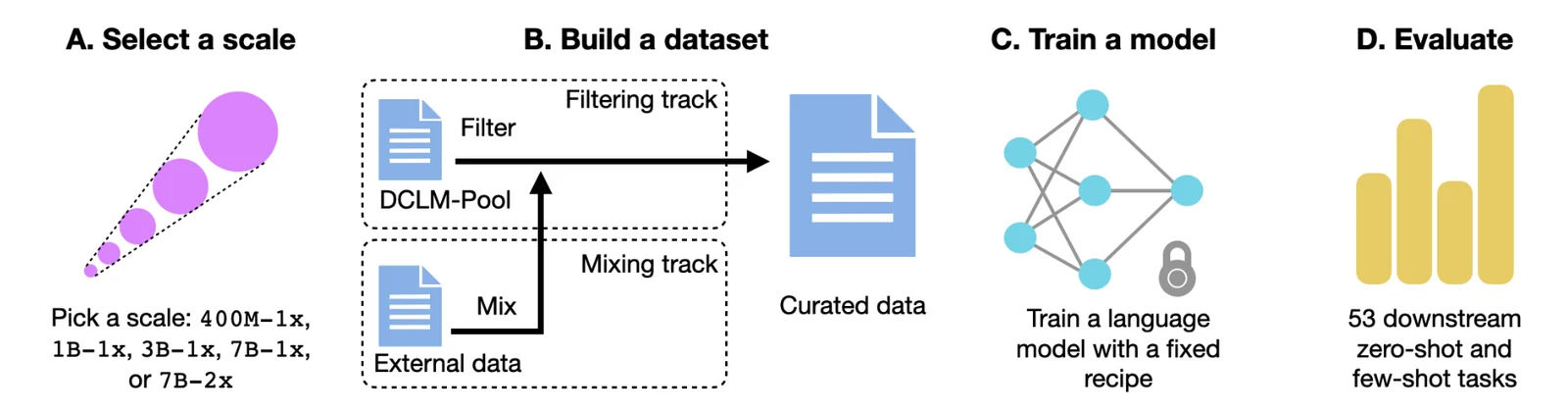
| DCLM-baseline | 3.8T tokens, filtered from a 240T-token pool | CC BY 4.0 (card: intended for research use only) |
| Dolma | v1.6: 3,059B Llama tokens, 4,367M documents (v1.7: 2.3T) | ODC-By (changed from AI2 ImpACT in April 2024) |
| Nemotron-CC | 6.3T tokens (4.4T real deduplicated + 1.9T synthetic) | not stated in the paper |
| RedPajama-Data-v2 | 30T deduplicated tokens, 5 languages | code Apache 2.0; data governed by Common Crawl terms |
| The Pile | 825.18 GiB, 22 components; token count never published | code MIT; no data licence stated |
| Common Pile v0.1 | 7.6–8 TB (the paper gives both), 30 sources | built only from openly licensed sources; release licence unspecified |
| C4 (en) | 365M documents, 156B tokens, 305 GB | ODC-BY on the allenai/c4 card; not stated in the documentation paper |
How FineWeb was filtered, as a worked example
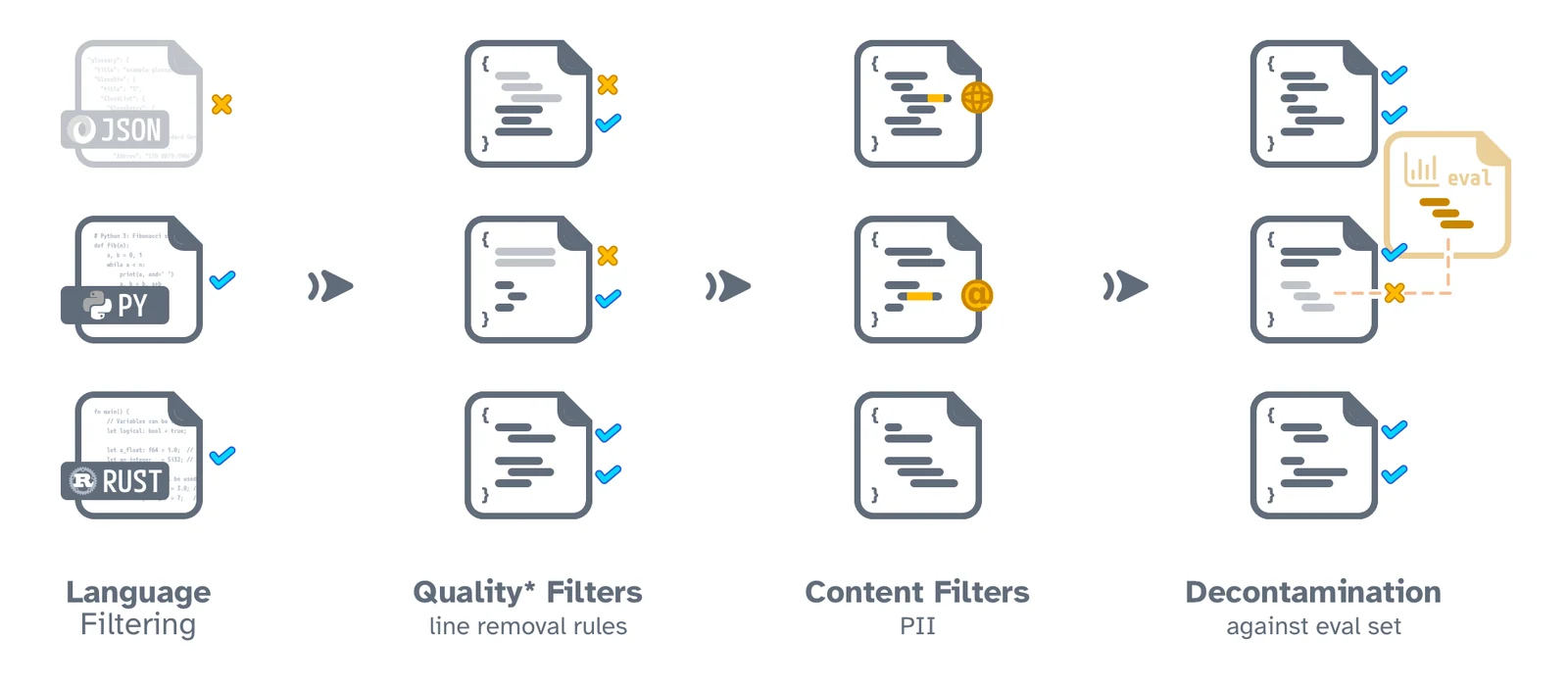
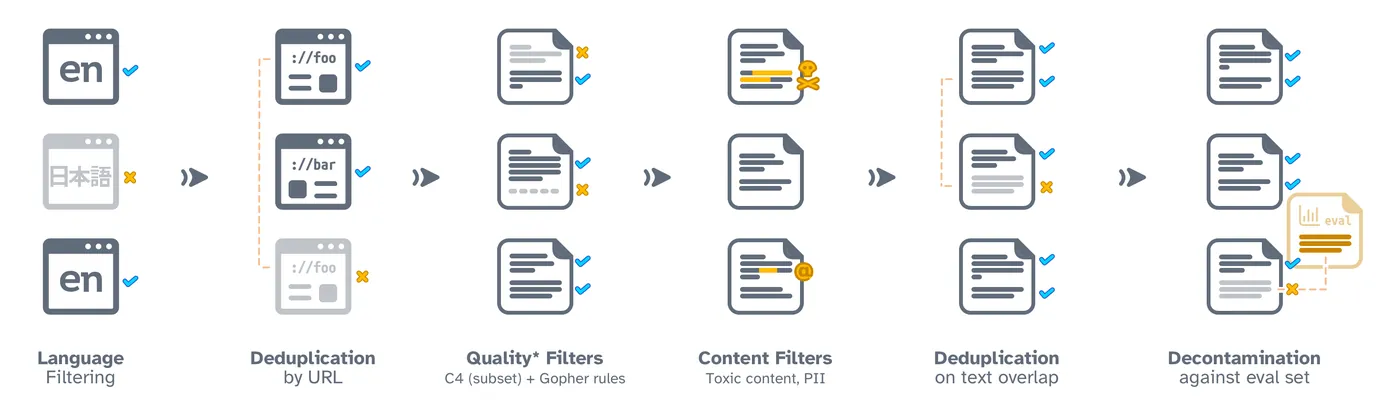
Filtering is where these corpora actually differ, and FineWeb documents its pipeline more fully than most. Text is extracted from Common Crawl WARC files with trafilatura favouring precision, then passed through a URL blocklist, a fastText English classifier at a score threshold of 0.65, and the MassiveText quality and repetition filters.
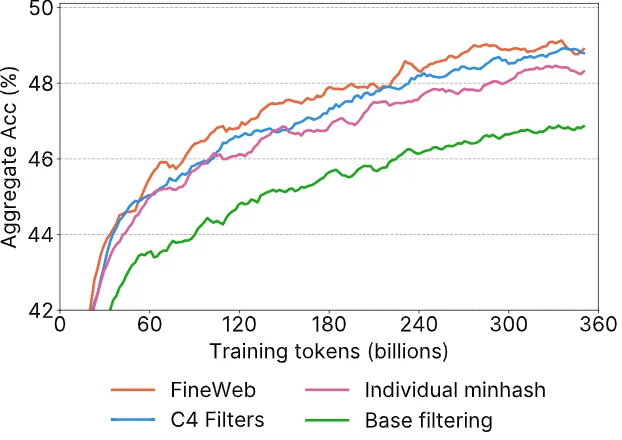
Deduplication is MinHash with 5-gram shingles and 112 hash functions, and — this is the unusual choice — applied per crawl dump independently rather than globally. Three custom filters follow, and the team reports what each cost: requiring that at least 12% of lines end in punctuation removed 10.14% of tokens, a duplicated-line-characters threshold removed 12.47%, and a short-lines filter removed 3.73%. Together about 22% of tokens.
FineWeb-Edu then goes further by scoring for educational quality. A large instruct model rated 460,000 samples from 0 to 5; a smaller embedding model plus a regression head was trained on 410,000 of those ratings, with the remaining 50,000 held out for validation, reaching an F1 of 82% at threshold 3. Applying that threshold removed 92% of FineWeb, leaving 1.3T tokens.
Aggressive filtering helps, up to a horizon
FineWeb-Edu's filtered 1.3T tokens outperform the full FineWeb on MMLU, ARC and OpenBookQA, and per the paper match the final MMLU of the Matrix corpus with almost ten times fewer tokens. The threshold is a trade-off: per the dataset card, stricter ones significantly degrade HellaSwag and PIQA, which is worth knowing before you adopt it wholesale.
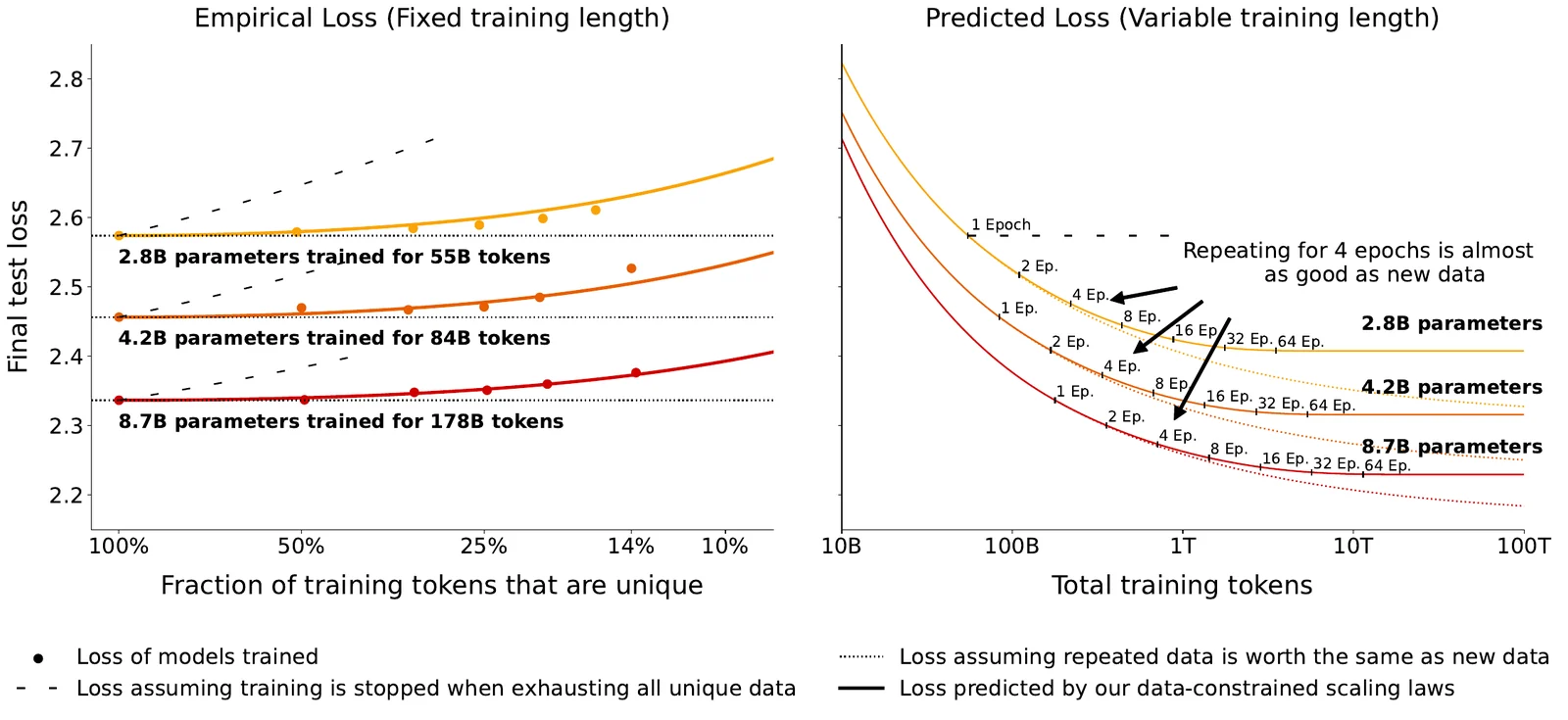
But Nemotron-CC publishes the counter-argument, and it is the most practically useful finding in this whole area. At a 1T-token budget its high-quality subset scores 59.0 MMLU against DCLM's 53.4 — filtering wins. Its full 6.3T-token dataset, trained for the same 1T tokens, scores 53.0, roughly on par with DCLM — but it holds four times as many unique real tokens as DCLM, whose 3.8T is about 80% near-duplicates (some 1T unique). That is the point: aggressive filtering leaves you too few unique tokens to train on for long, so a long run starts repeating.
The practical reading: if you are training for a short horizon, filter hard. If you are training for a long one, you need unique tokens more than you need the highest-scoring ones. Nemotron-CC's answer is to keep more and manufacture more: classifier ensembling and fewer heuristic filters raise the yield of real tokens, and 1.9T of its 6.3T tokens are synthetic rephrasings of real documents, generated with an open 12B instruct model (Mistral NeMo 12B Instruct).
Provenance is a separate question from licence
A corpus can carry a permissive licence and still have uncertain provenance, because the licence covers the packaging rather than every underlying document. RedPajama-Data-v2 is explicit about this: the code is Apache 2.0 while the text itself is governed by Common Crawl's terms of use.
The Pile illustrates the other failure mode. Its code is MIT, no licence is stated for the data, and its Books3 component — roughly 12% of the corpus — became copyright-contested and is no longer distributed, though it remains in the published component table. A corpus is not a fixed object over time.
If you intend to ship a model commercially, the question to ask of a corpus is not whether it is open but whether its provenance is documented well enough to defend. That is a much shorter list.
Questions people ask
Do I need to pretrain at all?
Almost certainly not. Pretraining from scratch costs millions of GPU-hours and the open base models have absorbed more data than you can afford to. The realistic uses of these corpora are continued pretraining on a domain slice, or sampling from them to build a smaller specialised mix. Starting from a base model is the default for essentially everyone.
What does 'tokens' mean across these numbers?
Not the same thing in every row, which is why cross-corpus comparisons are loose. Dolma counts Llama-tokenizer tokens, FineWeb GPT-2 tokens, C4's documentation counts with a SpaCy tokenizer, and The Pile declines to give a token count at all — reporting bytes plus a tokens-per-byte ratio instead. Treat the figures as order-of-magnitude comparable, not exact.
Is more data always better for pretraining?
For pretraining, scale genuinely does help — unlike instruction tuning, where it often does not. But quality of filtering competes with quantity: in DCLM, MMLU ranged from 35% to 44% at 7B scale purely by changing the filter, with the pool size fixed. Both axes matter, and filtering is the cheaper one to improve.
Can I mix several of these corpora?
Yes, and that is normal practice — Dolma and The Pile are themselves curated mixtures with per-source weights. Deduplicate across sources before mixing, since the web-derived corpora overlap heavily, and keep the per-source weights recorded so the mix is reproducible.