Qwen's distinguishing features for data preparation are breadth and multilingual strength: the family spans a very wide size range with specialised variants, and the base models are genuinely competent outside English.
Multilingual competence changes your data plan
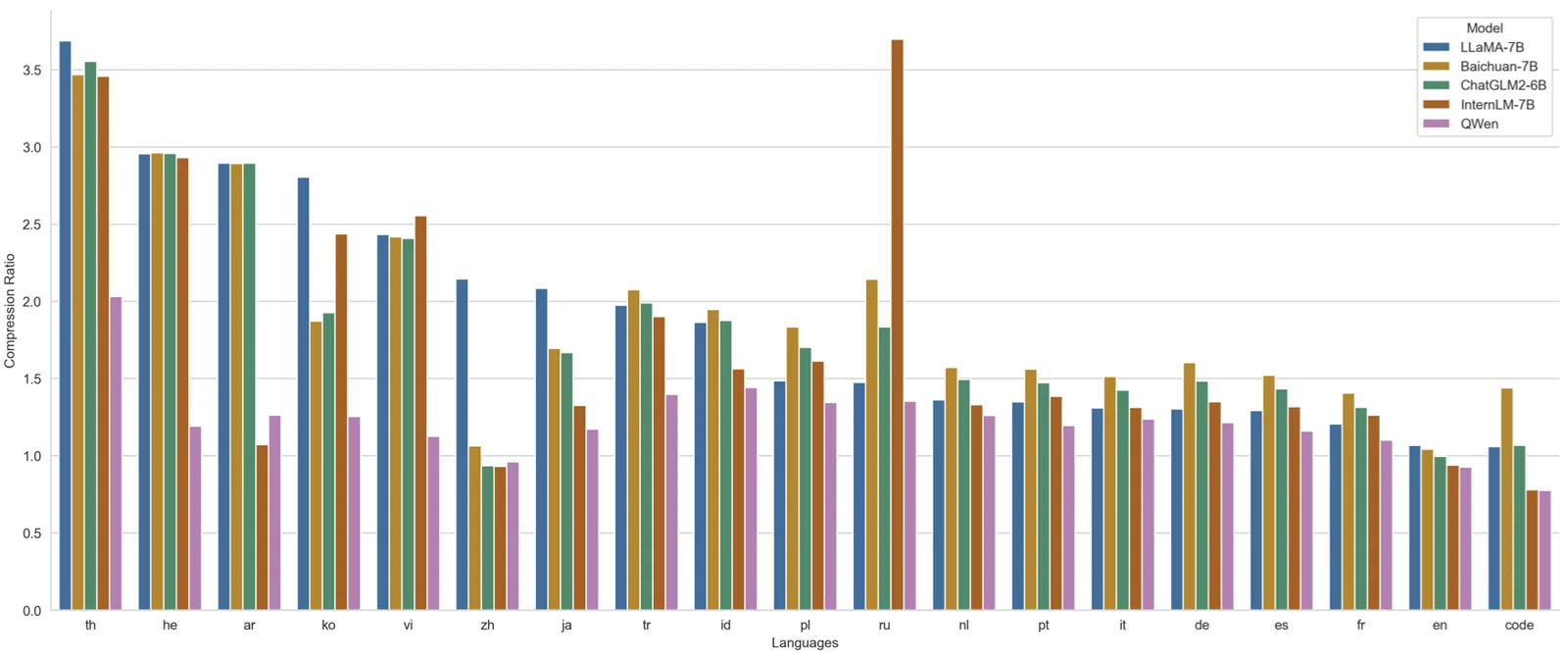
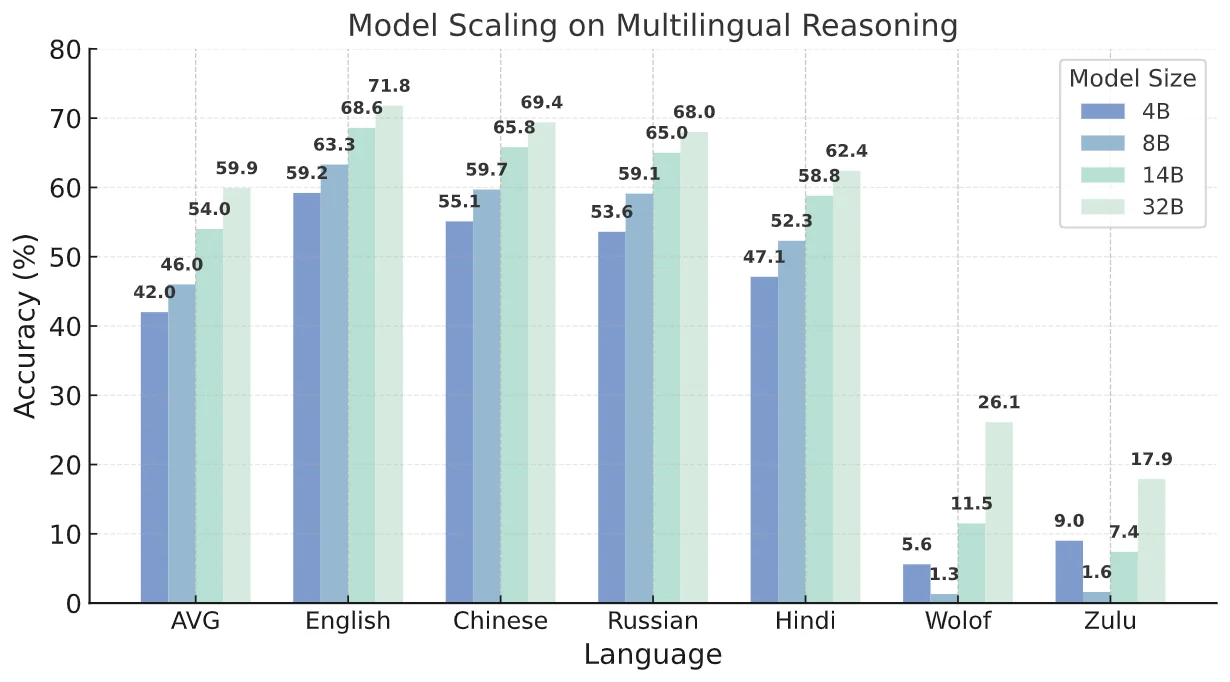
The Qwen base models have substantially better non-English coverage than much of the open field, Chinese especially but by no means only. That matters because it changes which stage of training you need.
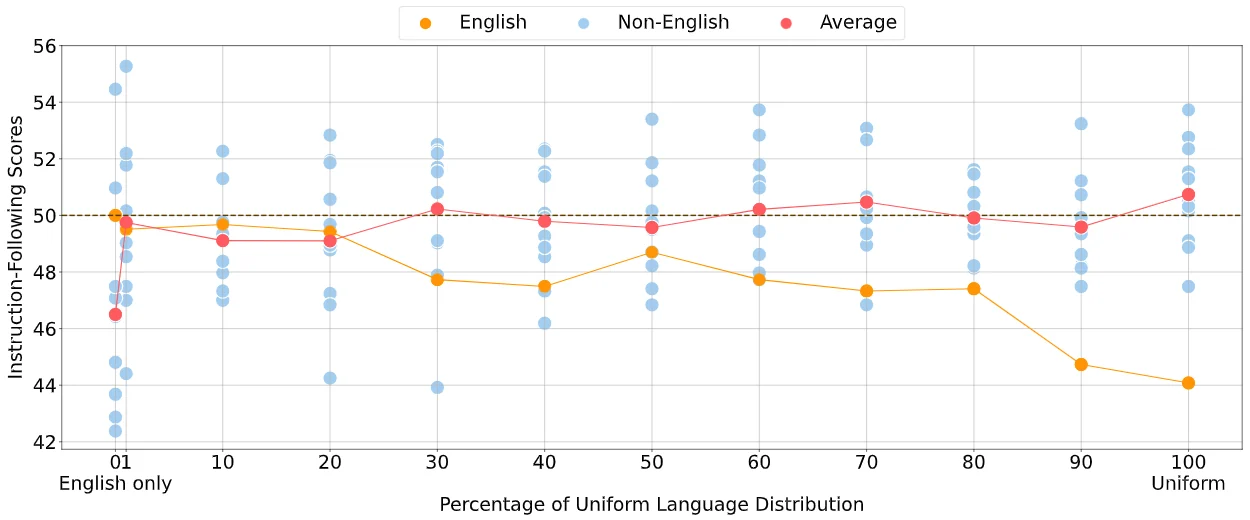
The usual assumption with a non-English application is that you need continued pretraining to give the model the language. If the base model already has reasonable competence, you do not — you need instruction data in that language to teach it to respond in it, which is a far smaller and cheaper dataset.
So test before you plan. Prompt the instruct model in your target language with a few examples and read the output critically. If the language is fluent and only the format or register is wrong, you are in behaviour territory: hundreds to a few thousand examples. If the language itself is weak, that is a knowledge gap and continued pretraining applies, which is orders of magnitude more data.
Pick the right variant before preparing data
This family is unusually broad, and the variant determines what your data has to look like. The families include general instruct models across a wide size range, coding-specialised releases, maths-specialised releases, vision-language models, and reasoning or thinking-oriented models.
The data implications differ substantially. A vision-language variant needs image-text pairs with the images referenced in a model-specific per-row shape. A coding variant is already strong at code and should be fine-tuned on your conventions rather than on general programming. A reasoning variant expects and produces extended working, which changes both your sequence length budget and what a good training example looks like.
Starting from a general instruct model when a specialised variant exists for your task usually means paying in data for capability you could have had for free.
Thinking-mode templates need care
Models that produce explicit reasoning traces separate the thinking from the final answer with special tokens, and this is reflected in their chat templates. Unsloth's template collection carries distinct entries for instruct and thinking variants in this family, which is the signal that you cannot treat them interchangeably.
Two consequences for your data. First, if you are fine-tuning a thinking model on data that has no reasoning traces, you are training it to skip the step it was built around — sometimes that is what you want, often it is not, and you should decide deliberately rather than by default. Second, the loss masking question gets more complicated: you may want loss on the reasoning, on the answer, or on both, and the right choice depends on whether you are teaching the reasoning or just the output format.
As ever, render an example and read it. With reasoning models this is doubly worth doing, because the token structure is less familiar and more consequential.
Settings
Standard data contract — a messages list, loss on assistant turns, see the TRL dataset contract. The breadth of the size range is the practical variable here.
From Unsloth's memory table: roughly 3.5 GB for a 3B model at 4-bit, 5 GB at 7B, 8.5 GB at 14B, 26 GB at 32B and 41 GB at 70B-class, against 8, 19, 33, 76 and 164 GB respectively for 16-bit LoRA. That spread means you can usually prototype on a small variant and scale up once the data is proven, which is a cheaper way to work than starting large.
Rank 16 to 32, alpha equal to rank or double, 2e-4 for SFT, one to three epochs, and much lower for preference tuning. Note that specific model version strings in this family change quickly — check the current documentation for your checkpoint rather than trusting a version number in any article, including this one.
Questions people ask
What licence do Qwen models use?
It varies by release, with much of the family under Apache 2.0 and some releases under their own terms. As with every family here, check the specific checkpoint rather than inferring from another model in the family.
Should I use the vision variant for documents?
Often yes. If your inputs are scanned documents or screenshots, a vision-language variant lets you skip a separate OCR stage and its error propagation. The data cost is that you need image-text pairs in that model's expected per-row format, which is more involved than text instruction data.
Can I fine-tune a thinking model to stop showing its working?
Yes, by training on data with final answers only — but consider whether you want that. The reasoning is where the capability comes from on hard tasks, and suppressing it in training can cost accuracy. Hiding the trace at the application layer is often the better answer than training it away.
How much data do I need?
The published figures come from Unsloth's documentation, not from the model's maker: a minimum of 100 rows with over 1,000 preferable for supervised fine-tuning, at 1–3 epochs, and at least 500 rows for GRPO. Nothing is published for DPO-style preference tuning. See how much data for a LoRA for the doubling experiment that answers it for your task rather than in general.