Text classification is the most mature task in NLP and still the one where people most often pick the wrong dataset — because label schemes that look compatible are not.
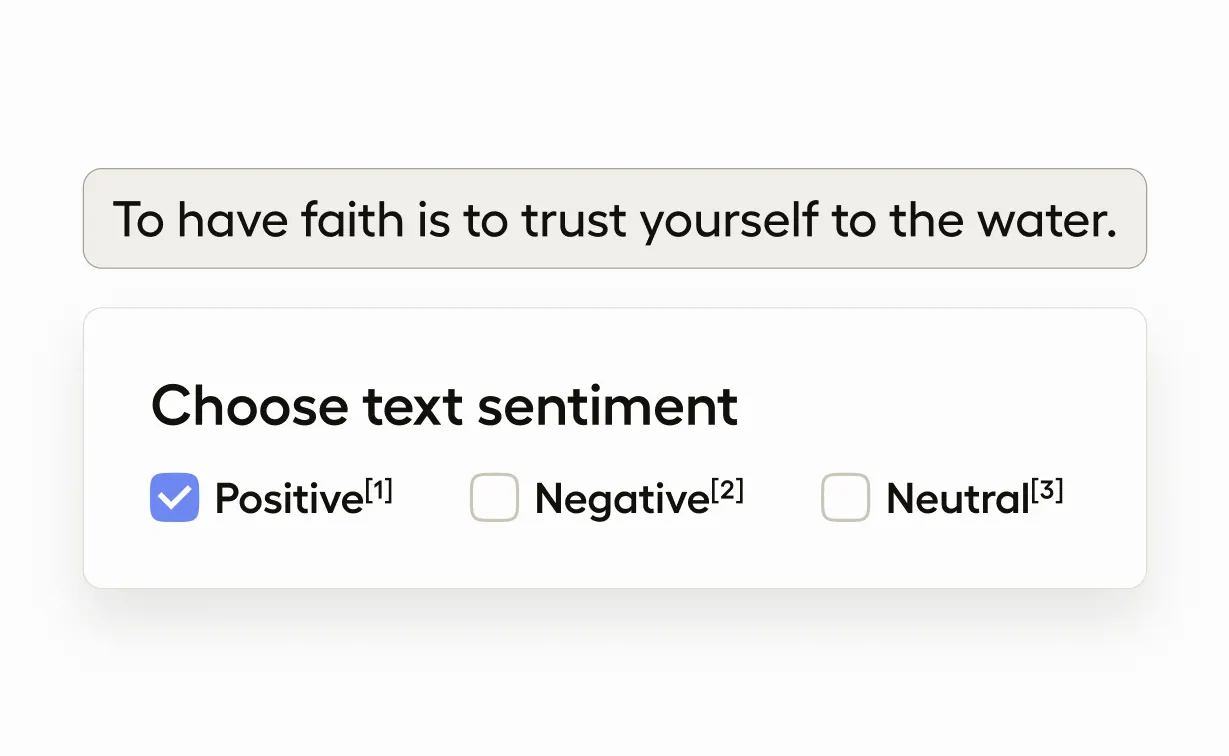
The trap in this category is label-scheme mismatch. Binary positive-negative polarity, three-way with neutral, five-point star ratings, and fine-grained emotion taxonomies with dozens of categories are all called sentiment analysis, and a model trained on one does not transfer to another without remapping that loses information. Check the exact label set before the dataset size.
The second issue is domain. Sentiment models trained on product reviews perform notably worse on social media, and worse again on support tickets or clinical notes, because the vocabulary, length and conventions of expressing opinion differ. If your inference distribution is not reviews, a review dataset is a weaker starting point than its size suggests — read twenty rows and ask whether they resemble your traffic.
| Dataset | Modality | Size | Licence | Best for |
|---|---|---|---|---|
| GoEmotions | Text | 58,000 examples | CC BY 4.0 | Emotion detection from text |
| Amazon Polarity | Text | 4M reviews | Apache 2.0 | Sentiment classification for e-commerce |
| Twitter Sentiment Analysis Dataset | Text | 1.6M tweets | Twitter API terms | Sentiment classification on short texts |
| Chinese Sentiment Analyze | Text | 182,762 examples | MIT | Sentiment classification in Mandarin |
| Sentiment Analysis for Mental Health | Text | 51,000 texts | ODbL | Classification of mental states from text |
| Women's E-Commerce Clothing Reviews | Text | 23,486 rows | CC0 | Sentiment analysis or review classification |
| Civil Comments - Corpus of moderated comments annotated for toxicity | Text | 2M comments | CC0 | Toxicity detection and automated moderation |
| Coarse-Discourse - Annotated corpus of speeches on Reddit forums | Text | 116,000 comments | CC BY 4.0 | Understand and classify speech acts |
| E-commerce Text Classification | Text | 50,425 entries | CC BY 4.0 | NLP models to classify products |
| Clickbait Title Classification | Text | 32,000 titles | MIT | Short-text binary classification |
| Dataset Banking77 - Banking Customer Service Intentions | Text | 13,083 examples | CC BY 4.0 | NLP intent detection in banking |
| Resume Screening Dataset | Text | 10,174 lines | MIT | Automated screening systems for recruiters |
GoEmotions
- Size
- Approximately 58,000 plain text examples with multi-label annotations (Parquet on Hugging Face; CSV and TSV in the original repository)
- Licence
- CC BY 4.0 for the data (Apache 2.0 covers the code)
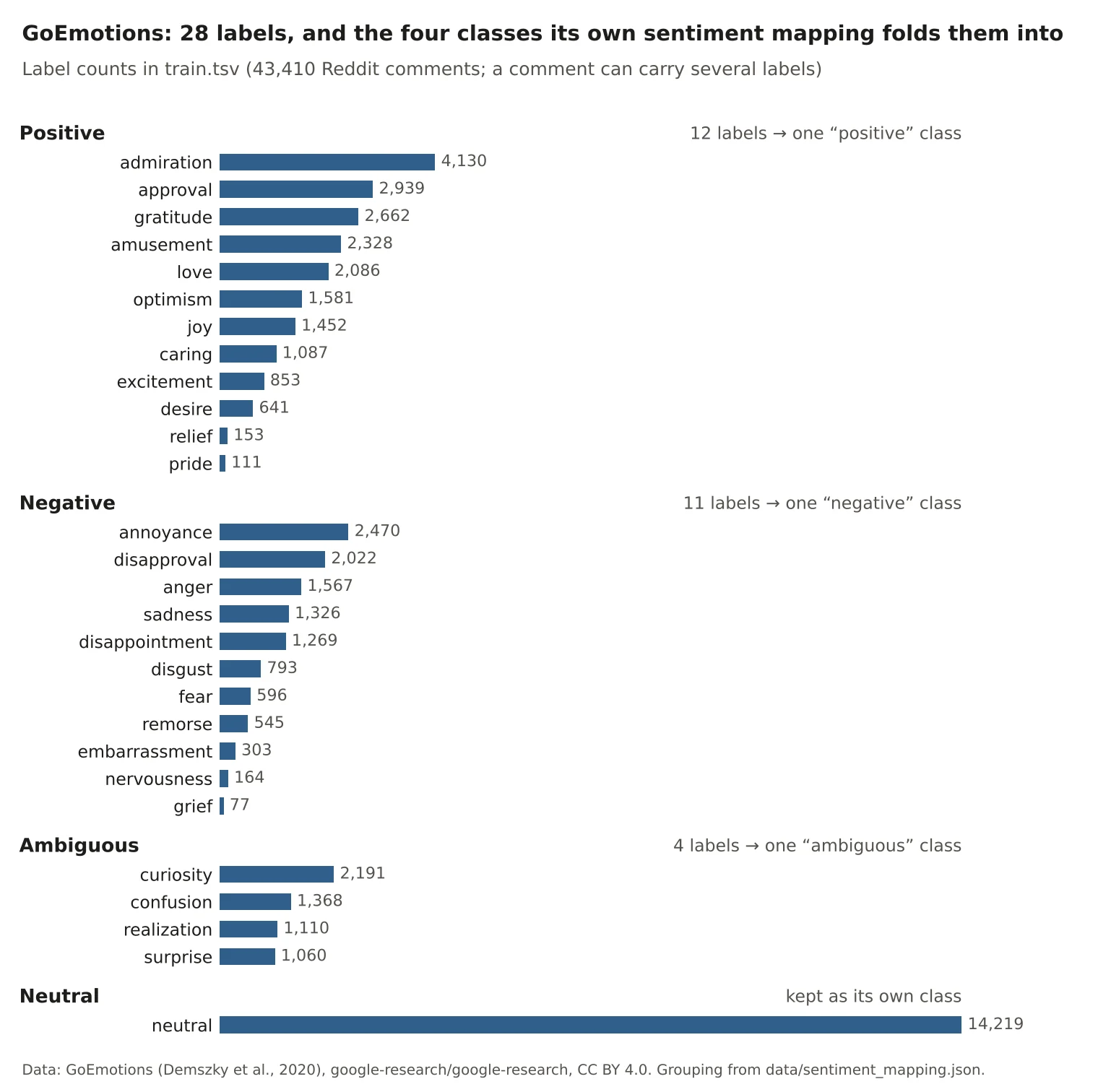
About 58,000 Reddit comments with multi-label emotion annotations across 27 emotion categories plus neutral. The fine-grained taxonomy and multi-label design make it far richer than positive-negative sentiment sets.
Training emotion detection from text, developing empathetic chatbots or assistants, and improving automatic moderation and detection of sensitive speech.
Source: innovatiana.com
Amazon Polarity
- Size
- Around 4 million reviews (train + test), JSON format with title, content and binary label fields
- Licence
- Apache 2.0
Around four million Amazon customer reviews in JSON with title, content and binary positive-or-negative label, spanning eighteen years of commerce. Large and permissively licensed, it is the workhorse sentiment classification corpus.
Training sentiment classification for e-commerce, improving customer feedback analysis and recommendation, and testing NLP robustness on large real-world volumes.
Source: innovatiana.com
Twitter Sentiment Analysis Dataset
- Size
- Approximately 1.6 million annotated tweets, in CSV format
- Licence
- Use subject to the Twitter API terms of use. Verification required for commercial uses
About 1.6 million English tweets in CSV labelled positive or negative automatically, from emoticons rather than by annotators (only the 498-tweet test set adds a neutral class). Note the licence defers to Twitter's (now X's) API terms rather than granting an open licence, so commercial use needs verification.
Training sentiment classification on short texts, analysing trends and opinion on social networks, brand monitoring, and improving moderation or opinion summarisation.
Source: innovatiana.com
Chinese Sentiment Analyze
- Size
- 182,762 examples of Chinese text (reviews and social posts), JSON/CSV format
- Licence
- MIT
182,762 Chinese-language examples in JSON and CSV, combining e-commerce product reviews with Weibo social posts, each labelled positive, neutral or negative. Covers both commercial and social registers.
Training sentiment classification in Mandarin, developing opinion analysis for commercial or social applications, and testing multilingual model robustness on everyday Chinese.
Source: innovatiana.com
Sentiment Analysis for Mental Health
- Size
- Approximately 51,000 texts (statements) annotated into 7 categories, CSV/JSON format
- Licence
- Open Database License (ODbL) or equivalent free license (please check before using)
Over 51,000 statements gathered from platforms such as Reddit and Twitter in CSV and JSON, each labelled with one of seven mental health states. Its catalogue page itself advises checking the licence before use.
Training classification of mental states from text, developing psychological support chatbots, and emotional analysis to detect mental health trends.
Source: innovatiana.com
Women's E-Commerce Clothing Reviews
- Size
- 23,486 rows in CSV format, text and categorical data
- Licence
- CC0: Public Domain
23,486 CSV rows of anonymised online clothing reviews combining free text with ratings, customer ages, recommendation flags and product categories. Compact, clean and a long-standing teaching set for applied NLP.
Training sentiment analysis or review classification, studying customer experience by age or product category, and exploring BERT, TF-IDF or Word2Vec on real data.
Source: innovatiana.com
Civil Comments - Corpus of moderated comments annotated for toxicity
- Size
- Approximately 2 million text comments in JSON format, with toxicity labels and types of abuse
- Licence
- CC0-1.0
Roughly two million English public comments in JSON, gathered from a news-site commenting plugin between 2015 and 2017, labelled for overall toxicity and for specific kinds of abuse. Public domain and large.
Training toxicity detection and automated moderation, analysing hostile online interaction dynamics, and testing multi-class and multi-label classification on long texts.
Source: innovatiana.com
Coarse-Discourse - Annotated corpus of speeches on Reddit forums
- Size
- About 116,000 comment annotations with Reddit IDs (no comment text), JSON, ~50 MB
- Licence
- CC-BY 4.0
Discourse-act annotations for about 116,000 Reddit comments in some 9,000 threads, in about 50 MB of JSON, with reply links, thread depth and subreddit metadata. The release holds annotations and post IDs, not the comment text, which you must retrieve from Reddit yourself.
Training models to understand and classify speech acts, analysing conversational interaction on forums, and improving moderation and discursive behaviour detection.
Source: innovatiana.com
E-commerce Text Classification
- Size
- 50,425 text entries in CSV, 4 classes
- Licence
- Attribution 4.0 International (CC BY 4.0)
50,425 product text entries in CSV, each labelled with one of four e-commerce categories. Simple and well-sized for supervised text classification baselines or catalogue auto-tagging prototypes; check the per-class counts before relying on a single accuracy figure.
Training NLP models to classify products from descriptions, setting up automatic categorisation in an e-commerce platform, and testing supervised classification algorithms.
Source: innovatiana.com
Clickbait Title Classification
- Size
- 32,000 press titles, CSV, binary annotation (clickbait/non-clickbait)
- Licence
- MIT
32,000 article headlines from various sites in CSV, each labelled 1 for clickbait or 0 for not. Short-text binary classification with a clear practical use in moderation and content ranking.
Training short-text binary classification, analysing linguistic strategies of online clickbait, and refining automatic detection models for moderation or SEO.
Source: innovatiana.com
Dataset Banking77 - Banking Customer Service Intentions
- Size
- 13,083 text examples with intent labels (77 classes)
- Licence
- CC-BY 4.0
13,083 real banking customer service requests, each labelled with one of 77 fine-grained intent categories. The high class count over short utterances makes it the standard hard intent-classification benchmark.
Training NLP intent detection in banking, improving customer-service chatbots or voice assistants, and analysing user needs and frustrations in detail.
Source: innovatiana.com
Resume Screening Dataset
- Size
- 10,174 lines, CSV and Parquet (34 MB approximately)
- Licence
- MIT
More than 10,000 sample resumes in CSV and Parquet, about 34 MB, annotated with relevance labels against a given position.
Developing automated screening systems for recruiters, training binary classification on applications, and testing NLP approaches for profile-to-offer matching.
Source: innovatiana.com
| text | emotion ids (decoded) |
|---|---|
| This is my favorite game of all time. Thanks for bringing back some good memories! | 15,17 (gratitude, joy) |
| Who is this Wild team? Where have they been? | 6,7 (confusion, curiosity) |
| Awesome! I’m a cradle [RELIGION], so really interesting to hear your experience. Thanks for sharing. | 0,13,15 (admiration, excitement, gratitude) |
How this list was put together
Drawn from the datasets in Dataset Finder filed under this topic, then checked by hand against what this page covers. A tag is a filing decision, not a description, so records that carried the tag without being about the topic were removed, and relevant records filed elsewhere were added. The order puts the closest fit first.
Sizes and licences come from each dataset's own documentation, vague wording included. Where we found a re-upload or catalogue card stating a licence that the original release contradicts — a CC0 tag on Flickr photographs, MIT on data whose terms require a signed agreement — the entry gives the original terms and says so. The comparison table abbreviates licences; hover a cell for the full wording.